Expanding to India? What the market intelligence needs to show before you commit.
India's opportunity is real. So is its complexity. Commitment-grade market intelligence closes the gap between the headline numbers and your specific viable beachhead, before the capital is allocated.
Your Objective
Commission market intelligence that answers whether the India opportunity is real, winnable, and worth the commitment for your specific sector, customer segment, and operating geography, before the capital allocation decision is made.
The Intelligence Gap
India’s 28 states operate as distinct regulatory environments. Most companies enter with a national overview and find themselves navigating state-specific compliance realities, competitive dynamics, and buyer behaviour that aggregate data did not reveal and the business plan did not account for.
How We Solve It
Dromley scopes the market intelligence brief to the specific sector, target states, and entry modes under evaluation. Primary research validates secondary analysis against on-the-ground reality. The output is a commitment-grade read, not a country overview, delivered before the board paper is written.
India sits on every growth shortlist right now. Its real GDP grew at 8.2% in FY2023-24, the fastest of any G20 economy, and sustained infrastructure investment is changing the distribution economics and supply chain feasibility that India entry planning has historically relied on. The hard work is the intelligence that determines whether your offer, entry mode, and operating model hold up in the specific market you are actually entering, not a generic version of India that averages away the complexity.
The gap between India’s aggregate headline and your viable beachhead is significant. India’s 28 states operate as distinct regulatory regimes, each with its own industrial policy, clearance timelines, and enforcement standards. A product priced and positioned for Mumbai’s formal economy may fail in Pune’s informal distribution channels. A franchise model that works in Gujarat’s organised retail environment requires complete rethinking for Tier-II markets in Madhya Pradesh.
What market intelligence for India entry does is close that gap before the capital commitment. It maps demand at the segment level, not the country level. It identifies which entry mode the regulatory environment actually supports for your specific sector. It assesses your competitive position against local players who understand price points, distribution infrastructure, and procurement cycles that no imported playbook has yet encountered. The question is not whether India is a compelling market. The question is: does your business have the specific intelligence to commit to the right market, the right mode, and the right motion, at the same time, with confidence?
What India Entry Intelligence Covers
Market intelligence for India entry is not a country overview report. It is a demand, competitive, and feasibility read, scoped to a specific sector, a specific customer segment, and a specific operating geography within India.
Demand intelligence answers whether the buyers you intend to serve actually exist in the volumes and at the price points your model requires, in the states where you intend to operate. India’s consumer and B2B segments fragment sharply across income levels, geographies, and formality of purchasing structure. A valid demand signal from a Bengaluru technology enterprise tells you nothing about procurement behaviour at a state government entity in Lucknow. Market intelligence maps the segment you are targeting, rather than the one that makes India look large in aggregate.
Regulatory and entry-mode intelligence answers which of the five principal entry structures: wholly owned subsidiary, joint venture, distributor or franchise arrangement, liaison office, or acquisition. The regulatory environment actually permits for your sector. One hundred percent foreign direct investment is permitted under automatic route in most sectors, but 26 sectors retain government approval requirements above specified thresholds. State-level compliance sits on top of the central framework. What clears in one state may require a different registration path elsewhere.
Competitive intelligence answers who holds the position the entrant intends to claim, and on what terms: price point, distribution reach, customer relationships, and brand recognition. India’s organised and unorganised markets coexist and compete on different terms. Understanding the competitive field before entry is what determines whether your offer can actually win, not whether it deserves to.
What distinguishes reliable India market intelligence from a standard country report?
A country report describes India at a macro level. Market intelligence for India entry is scoped to your sector, your target customer segment, and the states where you intend to operate. It maps demand at purchase-decision level, assesses which entry modes your sector permits, and sizes the competitive field you will actually face, rather than the one that makes the aggregate opportunity look compelling.
How does India's state structure change what market intelligence needs to cover?
India’s 28 states operate distinct industrial policies, regulatory clearance timelines, and enforcement standards. A compliant structure in one state may require entirely different registrations in another. A market intelligence brief must specify the target states, not just India as a national market, and map the regulatory path for each operating geography; otherwise the entry plan rests on assumptions that ground-level execution will contradict.
When the Board Needs This Read
Market intelligence for India entry is commissioned when a decision carries enough capital commitment and operational irreversibility that getting the read wrong is materially costly. That threshold arrives in three situations.
The first is greenfield entry, a wholly owned subsidiary or new operating entity in India for a business with no prior on-the-ground presence. The capital committed upfront, the 12-to-18-month operational setup timeline, and the organisational resources required to staff and manage the entity make this a decision where a flawed market assumption in month one compounds through every subsequent commitment. Intelligence commissioned before incorporation protects against building expensive infrastructure for a market segment that turns out to be smaller, more competitive, or more price-sensitive than the desk analysis suggested.
The second is expansion into a new Indian state or customer segment by a business that already operates in India. Companies with a successful base in a metro market frequently underestimate how different the operating environment, channel economics, and customer behaviour are in Tier-II and Tier-III geographies. Intelligence that worked for Maharashtra does not transfer automatically to Uttar Pradesh. The investment in getting that read right is an order of magnitude smaller than the cost of a failed expansion.
The third is acquisition, when speed to market is the primary objective and buying an existing Indian business offers a faster path than organic build. Acquisition in India introduces partner risk, integration complexity, and regulatory considerations that are poorly understood without prior intelligence on the target’s actual market position, compliance standing, and customer concentration. In each case, the intelligence is not commissioned to produce a green light. It is commissioned to ensure that the green light, when given, is defensible.
At what point in the entry planning process should market intelligence begin?
Before any capital allocation or entity formation decision. The intelligence brief should precede the board paper, not follow it. Once a subsidiary is incorporated, a distributor is contracted, or a site is selected, the intelligence is validating a commitment already made rather than informing one still open. Commissioned early, the read shapes the decision: mode, geography, timing, and sequencing of commitment.
Can a company rely on secondary market reports to make an India entry decision?
Secondary reports establish context but cannot replace primary intelligence. India’s market conditions change faster than syndicated research cycles. The competitive field in a specific sector and state may have shifted materially since the last published report. Regulatory enforcement standards and distribution channel maturity vary at state level in ways aggregated national data does not capture. Ground-level validation converts context into a commitment-grade read.
How the Intelligence Engagement Runs
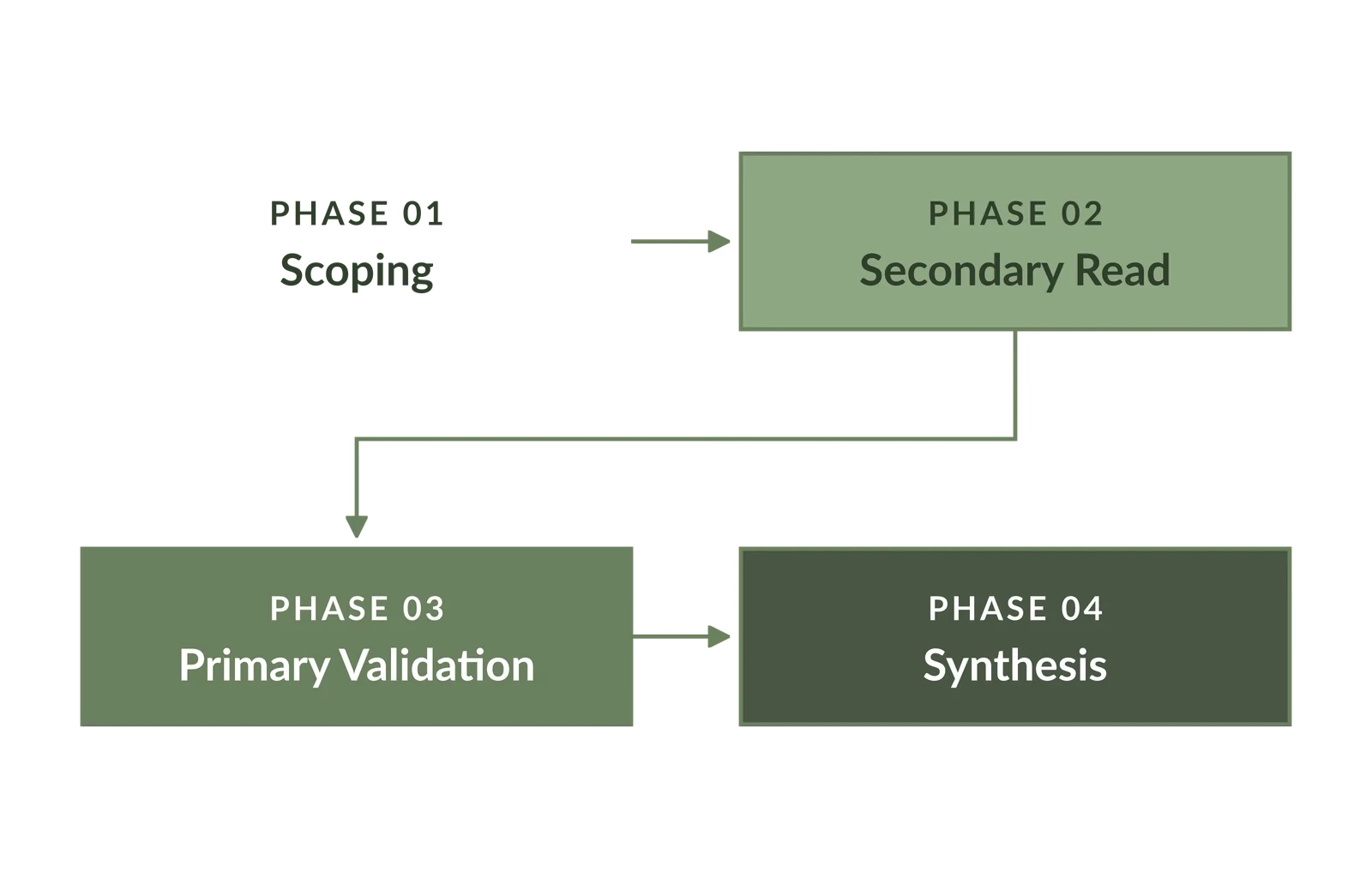
Every engagement opens with scoping. The intelligence cannot produce an actionable read without a defined scope: which sector, which customer segment, which states, and which entry modes are under evaluation. A poorly scoped brief produces a broad country analysis that answers no specific decision. A correctly scoped brief produces intelligence that maps the beachhead opportunity with enough precision that the entry plan can be built around it.
From scoping, the engagement moves to primary and secondary research. Secondary research establishes the regulatory framework, the published competitive landscape, and the economic context for the target market. Primary research, comprising structured interviews with potential channel partners, procurement decision-makers, regulatory intermediaries, and sector-specific operators, validates those secondary findings against on-the-ground reality. The gap between what secondary sources report and what primary research reveals is, routinely, the most useful output of the engagement. It is where the assumptions embedded in the business case are examined under pressure.
The third phase is synthesis and recommendation. The deliverable is not a data compilation or a country overview with a risk rating at the end. It is a recommendation on entry mode, geographic sequence, competitive positioning, and the conditions under which the entry case holds, and the conditions under which it does not. A senior-led engagement ends where the commitment decision begins.
What the Intelligence Has to Show
A market intelligence read for India entry is commitment-grade when it answers five questions without ambiguity.
First: does the target segment exist at the size and purchase price the business model requires? Second: which entry mode does the regulatory environment support for this specific sector in the target states? Third: who holds the competitive position the entrant intends to claim, and on what terms: price, distribution reach, customer relationships? Fourth: what organisational and compliance capability does the entry require, and does the firm currently have it? Fifth: what are the conditions, including market, regulatory, and competitive factors, under which the entry case reverses?
Intelligence that cannot answer these five questions has not yet produced a commitment-grade read. A board that approves an India entry without answers to all five is approving a bet, not a strategy.
What the Intelligence Reveals
Four data points define the India market intelligence context. Growth velocity, structural reform trajectory, productivity potential, and the competitive state of inbound investment each bear directly on what a commitment-grade entry brief needs to assess, and what a board paper built without it is missing.
8.2%
Growth Signal
India’s real GDP grew at 8.2% in FY2023-24, the fastest rate among all G20 economies, while infrastructure investment as a share of GDP climbed from 5% in the prior decade to over 7.5% since 2023. The combination of economic velocity and infrastructure build rewrites the distribution economics and supply chain feasibility assumptions that India entry planning has historically relied on. Market intelligence that uses pre-2023 assumptions about logistics infrastructure, cost structures, and market reach will produce entry plans calibrated to a market reality that has substantially changed.
39th
Reform Trajectory
India ranked 39th on the 2024 WIPO Global Innovation Index, up from 81st in 2015, a 42-position improvement over nine years. This trajectory reflects structural changes in intellectual property frameworks, technology infrastructure, and research and development investment capacity that alter the quality of local partners, the depth of technical talent pools, and the competitive intensity of the domestic field. An entry assessment built from data assembled before this reform cycle will systematically underestimate what a well-resourced local competitor, or a well-chosen local partner, is now capable of.
40%
Productivity Headroom
IMF analysis published in January 2026 found that strengthening innovation across India’s economy could boost productivity growth by 40%, equivalent to adding the output of the country’s fourth-largest state economy. This productivity headroom sits unevenly across sectors and geographies. Market intelligence that maps where the gains are concentrating, in manufacturing, digital services, and financial technology, identifies the segments where market dynamics are moving fastest and where the competitive window for a well-positioned new entrant is narrowest.
$44B
FDI Context
India attracted $44 billion in foreign direct investment equity inflows in FY2023-24, placing it consistently among the world’s top five inbound investment destinations. This volume signals a competitive entry environment, not an open one. The companies now establishing Indian operations include sector leaders calibrating pricing, channel strategy, and talent acquisition for a decade-long horizon. Market intelligence commissioned at entry does not simply validate the opportunity. It assesses the competitive state of an entry race that is already underway.
Decks are easy. Decisions are not.
Bring us the real question. We’ll come back with how we’d approach it. Not a brochure. A starting point.
Take the Next Step