Evaluating change management consulting firms? What the engagement needs to deliver.
The gap between a change program being announced and the organization actually operating differently is where most transformation value is lost. The firm you choose determines whether that gap closes.
Your Objective
Engage a change management consulting firm that carries the brief from organizational change diagnosis through adoption delivery, under one accountability line, without the program fragmenting between a strategic recommendation and a separate implementation partner.
The Intelligence Gap
Most change programs fail not because the strategy was wrong but because the organization was not equipped to move from strategic decision to operational reality. The firm that runs the diagnostic rarely stays through delivery. The one that runs delivery was not present for the diagnostic. The client pays for both and manages the gap between them.
How We Solve It
Dromley assesses the organizational change brief, routes the right practitioner expertise to it, and remains the single line of accountability from readiness assessment through adoption. One engagement covers the diagnosis, the change architecture, and the delivery. The client does not coordinate between an advisory firm and a delivery vendor.
A buyer searching for change management consulting firms is not looking for a list. They are looking for a firm that can assess what organizational change their brief actually requires, deploy the right expertise to it, and remain accountable for whether the organization operates differently at the close of the engagement. The selection criteria are not whether the firm uses a recognized methodology. They are whether the firm can demonstrate delivery in programs structurally similar to yours, under one accountability line, without passing the brief to a subcontractor at the moment of implementation.
Change management consulting covers the people side of organizational transitions that would otherwise stall or fail. The scope is everything that happens between a strategic decision and its adoption: stakeholder alignment, change readiness assessment, resistance identification, and the sequencing of the transition so that people and process land together rather than serially. When the strategy calls for a commercial team to operate in a fundamentally different way, a technology platform to be adopted at scale, or two organizational cultures to integrate after a merger, the change management brief is the execution brief.
The organizations that get this wrong typically make one of two errors. The first is engaging one firm for the diagnostic and a different firm for the delivery, creating a handover that loses the readiness assessment and forces the delivery partner to rediscover what the diagnostic already mapped. The second is treating change management as a communication function: producing announcements and training materials while the organization’s behavioral resistance to the change goes unaddressed. Neither approach closes the gap between announcement and adoption.
Strategy defines where the organization needs to go. Project management tracks whether the program is on time and on budget. Change management consulting is what determines whether the people asked to operate differently once the program closes actually do.
When Organizations Engage This Work
The signal that a change management consulting engagement is necessary is when a transformation has a clear strategic case but no structured plan for how the organization moves from its current state to the one the strategy requires. That gap is where most transformation value is lost.
The three most common entry points: a go-to-market model that requires the commercial team to pursue customers, partners, or geographies in a fundamentally different way than they currently do; a merger or acquisition where two operating cultures, incentive structures, and customer relationship models need to integrate into a coherent operating entity; and a technology adoption program where the platform has been procured but the organization has not shifted its behavior to use it effectively.
The timing of engagement matters as much as the quality of the firm. Change management consulting commissioned before the transformation design is finalized shapes the change architecture from the start. Commissioned after the design has been announced, it is managing resistance to decisions that cannot easily be reversed. The organizations that achieve the fastest time-to-adoption engage change management capability at the design stage, not the communication stage.
What does change management consulting cover that internal HR or project management does not?
HR manages the employment relationship and organizational policy. Project management tracks delivery timelines and budget. Change management consulting addresses the transition between what the strategy requires and what the organization is prepared to do: the resistance patterns, alignment gaps, and behavioral shifts that neither HR nor PM disciplines are structured to diagnose or resolve. In a commercial transformation, the change management engagement is accountable for whether the organization actually operates differently at the close of the program, not whether it was trained, communicated to, or kept on schedule.
At what point in a transformation should a change management firm be engaged?
Before the change design is finalized, not after it has been announced. Organizations that commission change management capability at the design stage use it to assess readiness, identify where structural resistance exists, and shape the sequencing of the transition. Organizations that commission it after the announcement use it to manage resistance to decisions already made, which is a more expensive and less effective use of the same capability. The earlier the engagement, the more it prevents rather than repairs.
How the Engagement Is Structured
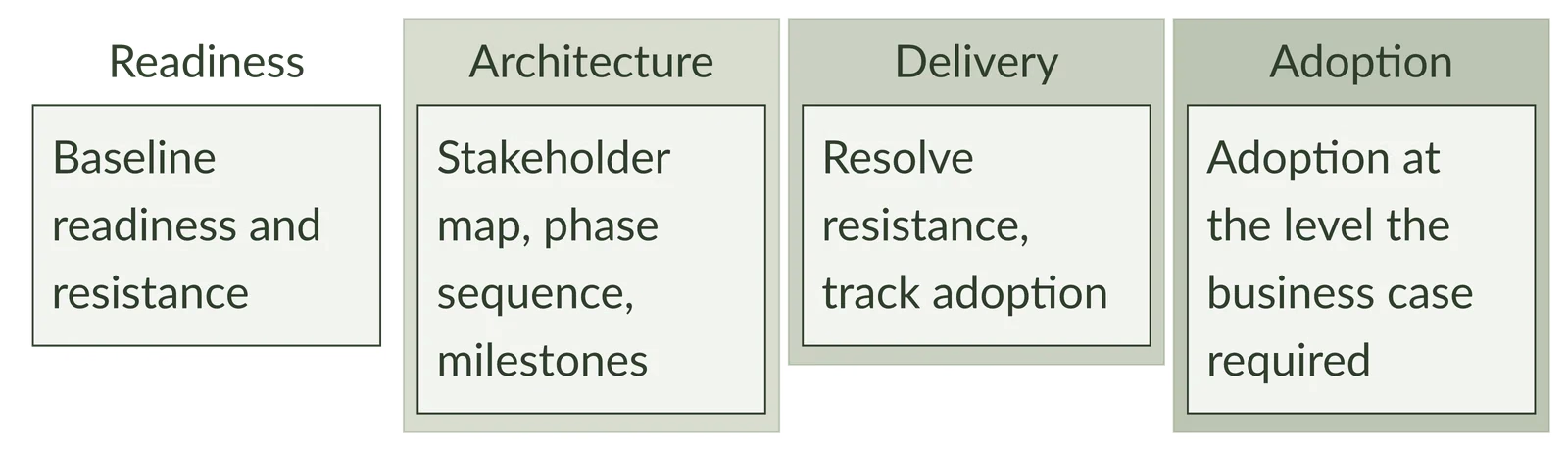
Every engagement begins with a readiness assessment. The change management firm needs to understand what the organization is being asked to do differently, who is affected, and where the structural resistance to that change is located before any delivery plan can be credibly designed. A change management engagement that skips the readiness phase and moves directly to communication planning is producing outputs before it has diagnosed the problem.
From the readiness assessment, the engagement defines the change architecture: the stakeholder groups, the sequencing of transition phases, the adoption milestones that mark whether the change is landing, and the intervention triggers that activate course correction when it is not. The architecture is not a communication calendar. It is an operational plan for moving the organization from its current state to the one the transformation requires.
Delivery covers the implementation of that architecture: stakeholder engagement at the right points in the sequence, resistance resolution as it surfaces, adoption tracking against the milestones, and senior-level reporting that gives the leadership team a clear read on whether the transformation is landing. The engagement does not close when the program is announced or when training is complete. It closes when adoption is demonstrably at the level the business case required.
How do we evaluate whether a change management firm has the right expertise for our brief?
The question to ask is not whether the firm uses a recognized change management methodology, but whether it can demonstrate delivery in programs structurally similar to yours. A post-merger commercial integration requires different change architecture than a technology adoption program or a go-to-market restructure. The firm should be able to describe what the organization was doing before, what the change required it to do differently, and what adoption looked like at the close of the engagement, not just what process it ran.
Can the firm that runs the change diagnostic also deliver the program, or should those be separate?
Separating the diagnostic from the delivery introduces a handover risk that is almost always underestimated. The firm that conducted the readiness assessment, identified the specific resistance patterns, and shaped the change architecture holds context that cannot be transferred cleanly to a new delivery partner. The delivery partner must rediscover what the diagnostic already mapped, which costs time and introduces the risk of working from a partial read. One accountability line from diagnosis through adoption is not just operationally cleaner, it is structurally less risky for the client.
What the Engagement Needs to Show
A change management engagement should close with demonstrable adoption, not a training completion report. The outputs that matter: adoption rates against the baseline established in the readiness assessment; stakeholder alignment scores at the milestones defined in the change architecture; the pace at which affected teams return to normal operating performance after the transition point; and a clear account of where resistance was encountered, how it was resolved, and whether any residual resistance requires monitoring.
Organizations that engage change management consulting as a diagnostic and delivery function, rather than a communication and training exercise, consistently achieve faster time-to-performance after the transition and lower cost of rework in the months that follow. The distinction between those outcomes and the average change program result is the quality of the readiness work done before delivery began.
The Change Execution Problem
Four data points frame the organizational change environment in which most transformation programs now operate. Each bears directly on why a structured change management engagement delivers materially different outcomes than a program that treats change as a communication function.
59%
Reskill by 2030
59% of the global workforce will need reskilling or upskilling by 2030, per the World Economic Forum’s Future of Jobs Report 2025 — and nearly one in five of that group are unlikely to receive it without deliberate intervention. That volume of behavioral and capability transition represents a structural change management brief: not a one-time training program, but an ongoing managed transition that requires deliberate change architecture, stakeholder alignment, and adoption tracking at scale.
64%
People Priority
A global survey of more than 3,000 CEOs across 30 countries found that 64% say succeeding with generative AI will depend more on people’s adoption of the technology than on the technology itself. The organizational change question, whether the people who need to operate differently will actually do so, is the same question in every transformation program. Technology procurement answers the capability question. Change management answers the adoption question.
16%
Change at Scale
Only 16% of organizations surveyed by Accenture in its 2024 Change Reinvented report are implementing all six capabilities of change management at scale — the combination of practices found to compound transformation value rather than deliver isolated wins. The remaining 84% are running fragments of a change capability, not a system. The gap between a change management engagement and a change communication program is the gap between the organizations building that full capability and those settling for isolated tactics.
5yr
Skill Shelf Life
The working half-life of a learned skill stands at approximately five years, and is contracting. Organizations that treat capability development as a one-time training event are operating on a return that expires faster than their investment cycle. Managed change programs that build behavioral change, rather than knowledge transfer alone, deliver adoption that compounds rather than decays against the next wave of organizational transition.
Decks are easy. Decisions are not.
Bring us the real question. We’ll come back with how we’d approach it. Not a brochure. A starting point.
Book a Briefing Call