Market Reads Competitive Intelligence & Benchmarking
What Competitive Benchmarking Misses in Mid Market B2B
Competitor benchmarking is only as reliable as the list of rivals it starts from. Research suggests experienced managers name competitors least accurately, and that firms ignore rival information already in plain view.
Overview
Most competitive benchmarking projects put their effort into scoring rivals on pricing, offer and market position, and very little into deciding which rivals to score. This analysis looks at that first step. It separates competitive intelligence, meaning what a firm actually knows about each rival, from benchmarking, the act of comparing that knowledge with its own position, and shows why the second can never be stronger than the first. Research on how managers identify competitors suggests that accuracy goes with better performance but declines with time spent in an industry, as the answer shifts from analysis to habit. A large field experiment by Kim, in a local services market, found that close to half of businesses did not know rivals' openly posted prices, and that those given the information changed course and often improved results. The piece then sets out why the industry's view, the management team's view and the buyer's view of the competition rarely match, and why buyers who chose someone else are the most useful and least consulted source. It is written for owners and commercial leaders at mid-sized B2B firms.
The deck




What It Means
The practical fix starts before any research is commissioned. Build the list of competitors from the business's real wins and losses, and from the alternatives buyers say they weighed, rather than from a meeting or a list of sector names. Then give someone the job of keeping it current, because the research points to inattention rather than missing data: price lists, company filings and job adverts are often public, and simply go unread. Interviews with lost buyers deserve a regular place in the process. Once a decision is made, a buyer has little reason to hold back, and their account of why a rival won is usually more candid than anything gathered during the sale. This is the approach behind our competitive intelligence and benchmarking work, which names rivals from your pipeline and reads their moves in sequence.
Common Questions
What is competitor benchmarking?
Competitor benchmarking compares a business with chosen rivals on measures such as price, product range, service and positioning, so management can see where it leads, trails or matches the market. Its value depends on two things: whether the rivals chosen are the ones buyers actually consider, and whether the information gathered about them is current. A careful comparison against the wrong set of competitors gives a confident but misleading result.
What is the difference between competitive intelligence and competitive benchmarking?
Competitive intelligence is the knowledge itself: what rivals charge, how they sell, who they win and lose against and what they appear to be preparing. Benchmarking is the comparison that uses this knowledge to place a business against its rivals. Intelligence comes first, because a benchmark built on thin or outdated information can only rank a business against an incomplete picture.
How do you identify your real competitors in B2B?
Start from the choices buyers actually made rather than from the sector. Review recent deals won and lost and note which suppliers buyers named; ask lost buyers who they chose and why; and check which firms appear on shortlists alongside yours. Compare that list with the one the management team would write from memory. Where the two differ, the buyer's version is usually the better guide to where competitive effort should go.
Transcript
DOWNSTREAM OF THOSE TWENTY MINUTES
Every competitor document starts with a list.
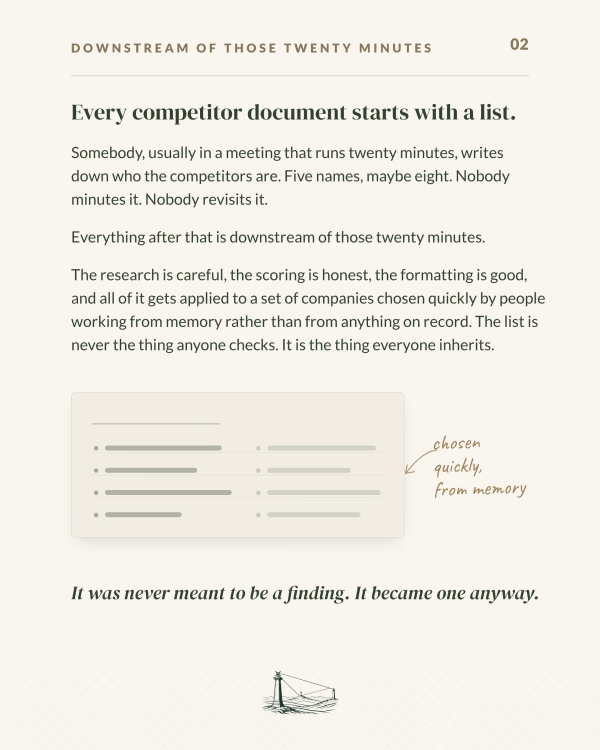
Somebody, usually in a meeting that runs twenty minutes, writes down who the competitors are. Five names, maybe eight. Nobody minutes it. Nobody revisits it.
Everything after that is downstream of those twenty minutes.
The research is careful, the scoring is honest, the formatting is good, and all of it gets applied to a set of companies chosen quickly by people working from memory rather than from anything on record. The list is never the thing anyone checks. It is the thing everyone inherits.
chosen quickly, from memory
It was never meant to be a finding. It became one anyway.
USED AS IF THEY WERE ONE
Worth separating two things, because they get used as if they were one.
Competitive intelligence
what you actually know about a rival. What they charge. Who they lose to, and why.
Benchmarking
the exercise of setting that against your own position and reading the distance between the two.
The second is only ever as good as the first, and the first is usually thinner than anybody involved wants to say out loud, because the exercise runs to a deadline whether or not the material arrived.
So the shape gets filled. What fills it is the question.
IT BECOMES A REFLEX
Here is the uncomfortable part.
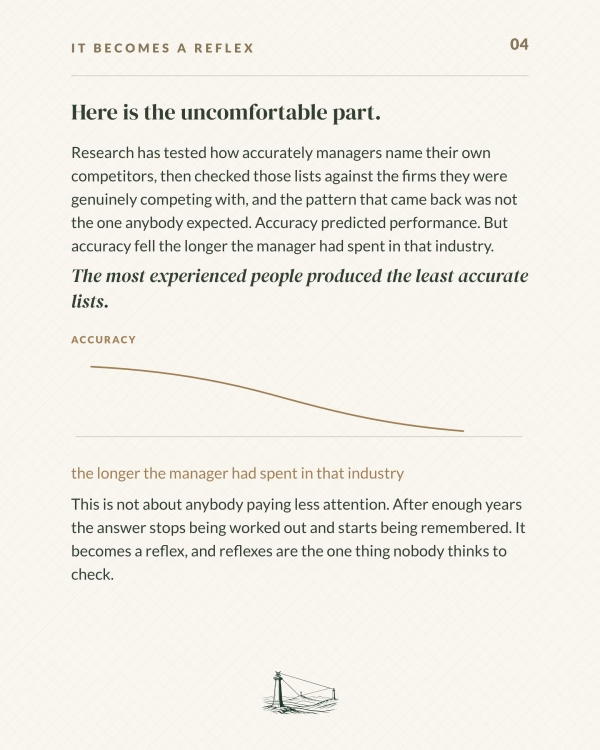
Research has tested how accurately managers name their own competitors, then checked those lists against the firms they were genuinely competing with, and the pattern that came back was not the one anybody expected. Accuracy predicted performance. But accuracy fell the longer the manager had spent in that industry.
The most experienced people produced the least accurate lists.
accuracy
the longer the manager had spent in that industry
This is not about anybody paying less attention. After enough years the answer stops being worked out and starts being remembered. It becomes a reflex, and reflexes are the one thing nobody thinks to check.
NOBODY HAD GONE TO LOOK
The usual answer is that the information simply is not available.
Somebody tested that. Across several thousand firms, in a market where rivals posted their prices in the open and anyone could look them up in minutes, close to half did not know what their nearest competitors were charging.
close to half
rivals posted their prices in the open
Not hidden. Not expensive. Just never collected.
When those firms were handed the information, they changed what they were doing, and they tended to do better afterwards. The material had been sitting there the whole time. Nobody had gone to look at it, and nobody was ever asked why not.
NOBODY IS ASSIGNED TO LOOK
Which changes the kind of problem this is.
If the information were genuinely out of reach, the answer would be a bigger budget, a better vendor, a longer engagement. That is the answer most firms reach for, and it is why the document gets thicker every year without ever getting any more useful to the person who has to decide something with it.
This is not an access problem.
It is an attention problem.
Nobody in the building is assigned to look, so nobody looks, and the annual exercise papers over the gap with whatever was to hand. Thicker is not the same as truer.
thicker every year
a bigger budget, a better vendor
THEY DO NOT AGREE
There is more than one list of your competitors, and they do not agree.
your industry
your management team
your buyers
the only one assembled by people who were actually choosing
Those three rarely match.
Most firms build the second, because it is free and it can be done in a meeting, and then spend real money researching companies their buyers never seriously considered. The buyer list predicts things. It is also the one you cannot write alone.
THE PART THAT GETS CUT
Which leaves the part that gets cut.
Somebody chose between you and a rival last year and did not choose you. They know what decided it, whether that was the price, or the proposal, or something nobody inside your business has ever considered.
Most of them are never asked.
While the deal was live they had every reason not to tell you, because nobody explains to a supplier they are about to turn down exactly why, with a meeting still to get through.
That reason is gone.
A rival's account is written to win work. A lost buyer's is written to nobody.
NAMED FROM THE DEALS YOU LOST
Here is how it runs.
Rivals named from the deals you actually lost, not a sweep of twenty firms the sector talks about and nobody in your pipeline has ever mentioned.
Prices, filings and hiring mean little alone. Read in sequence they show what a rival is preparing next. A plain call on every point you compete on.
Nobody here sells you a subscription that watches your rivals, so nothing in the findings has to sound alarming enough to be worth renewing.
The point is not knowing more about competitors. It is spending against the two actually taking your deals, and leaving the rest.
Sources & Further Reading
- The Value of Competitor Information: Evidence from a Field Experiment, Management Science (2025). Kim
- Managerial identification of competitors: accuracy and performance consequences, Journal of Strategic Marketing (2011). Clark
- Managerial Categorization of Competitors: Using Old Maps to Navigate New Environments, Organization Science (1996). Reger and Palmer
Decks are easy. Decisions are not.
Bring us the real question. We’ll come back with how we’d approach it. Not a brochure. A starting point.
Book a Briefing Call