Customer Experience (CX) Strategy Consulting
Your customer work splits into separate pieces: a journey map here, a survey there, and no one tying them together. Dromley runs it as one clear read your whole board can use and trust.
Your Objective
Give your buying group one shared, plain view of the customer, so strategy, journey design, and feedback data all point the same way before you spend a single dollar.
The Intelligence Gap
Your journey maps, surveys, and maturity reviews get built by different owners, on different schedules. Nothing ties what they find into one view your team can use.
How We Solve It
One Dromley partnership runs your full customer read: journey mapping, feedback design, and maturity scoring, seen together and owned by the partner who scoped it.
What This CX Engagement Covers
You get the full customer read here, not just one slice of it.
Journey mapping runs step by step across all your buyers. It covers the first look, sign-up, renewal, and growth, and each step names where things break down.
Voice of customer work becomes a closed loop. Feedback ties to a named owner and a set time to act, not a spreadsheet that goes nowhere.
Maturity scoring rates your team against a clear model, so you know where you stand before you spend more.
When Senior Leaders Bring This In
This work tends to start at one of four moments.
The first is when a new customer experience leader inherits years of scattered work. One team already built a journey map, another ran a survey, and no one owns the full picture. The board wants one clear read before it funds anything more.
The second is when customer scores stay flat despite real spending, and leadership needs a straight answer. Is the experience itself the problem, or is nobody tracking the moments that actually matter?
The third is a merger that puts two sets of customers under one roof, with two sets of journey guesses now colliding. Neither team’s data matches the other’s, yet both sides still want things to feel steady.
The fourth is when the board asks for one customer plan and gets back three dashboards that don’t agree with each other. Someone has to reconcile the numbers first, before the plan can mean anything at all.
What determines the scope of a CX strategy engagement?
Scope depends on what is already in place. Some organizations need journey mapping and feedback architecture built from nothing. Others already have a working survey program and need it reconciled with a maturity benchmark and a governance model. Dromley scopes to what is missing, not a fixed package.
How does journey mapping fit into a broader CX strategy?
Journey mapping names where the experience breaks down for each buying-group stakeholder. On its own, it is a snapshot. Inside a broader strategy, it becomes the evidence base for where to invest, feeding directly into the feedback architecture and the maturity benchmark rather than sitting in a separate deck.
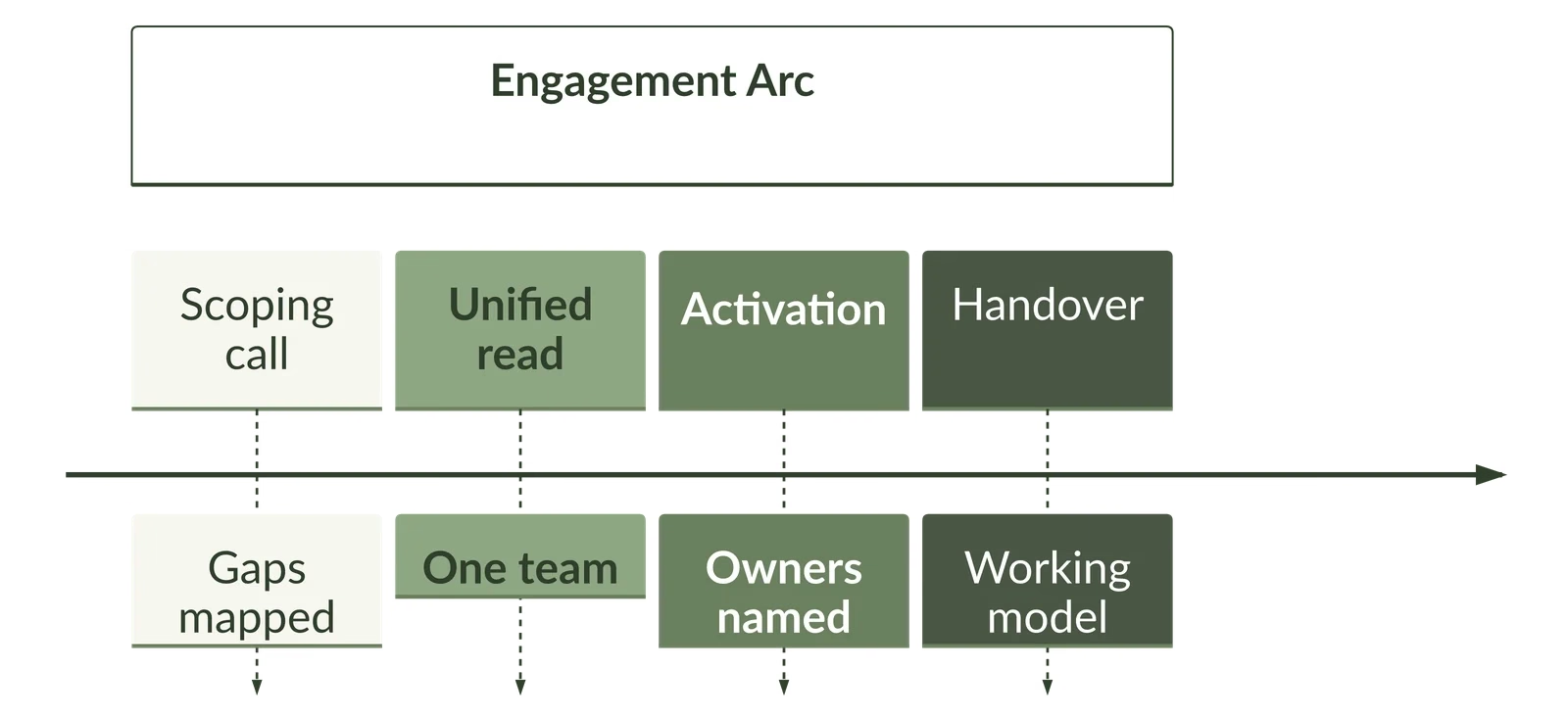
How A Dromley Engagement Runs
Your engagement opens with a scoping talk. We map what customer work already exists, and what is missing.
From there, one team runs your journey mapping, your feedback design, and your maturity scoring together. Nothing ships as three separate reports.
Findings turn into changes you can run. You know who owns each customer signal, and how it reaches budget talks.
The close is a working model your own team can run. It is not a one-time read that goes stale.
What makes a customer experience diagnosis credible to a board?
A credible diagnosis comes from evidence a board member can question directly: named methods, data sourced outside any system with a stake in the answer, and conclusions stated at the confidence the evidence actually supports. Anything softer reads as opinion, not diagnosis.
How is customer feedback data reconciled across teams?
Feedback data gets reconciled by assigning one owner to each customer signal and one response window for acting on it. Without that assignment, satisfaction surveys, support tickets, and journey research keep producing three different pictures of the same customer relationship.
What Has To Hold Up Under Scrutiny
Independent means your customer read comes from data outside any system with a stake in the answer. That includes Dromley’s own view.
Named means we state journey mapping and scoring methods in plain terms. A doubtful board member can question them directly, with no help needed.
Calibrated means the read says only what the facts back. Not more sure, not more careful than the data allows.
What The Value Data Shows
Customer value is not a soft concept. A large body of research ties it directly to satisfaction, advocacy, and renewal, the outcomes every customer program is built to move. The pattern that stands out most is what happens when these signals are read together instead of apart.
37%
Value And Satisfaction
A large cross-industry meta-analysis found that how customers rate the value they receive tracks closely with how satisfied they end up being. The link holds across industries and company sizes. That is why one credible read of customer value carries more weight with a board than three separate surveys ever will.
24%
Value And Advocacy
The same research ties customer-perceived value to how likely people are to recommend a company to others. Word of mouth is one of the cheapest, most trusted growth channels available, and this finding says it is not random goodwill. It tracks with the same value signal a structured CX read is built to surface.
28%
Value And Renewal
The research also connects perceived value to whether customers plan to keep buying. In accounts with a real renewal decision each cycle, that connection matters more than almost any signal leadership tracks. It speaks to future revenue, not just how the last interaction felt.
49%
The Full Picture
The same researchers also combined every driver they examined, spanning benefit factors, cost factors, and overall perceived value. That full model explained close to half of what separates a satisfied customer from an unsatisfied one. No single lens gets there alone. That is the case for treating customer work as one read, not three separate projects.
Decks are easy. Decisions are not.
Bring us the real question. We’ll come back with how we’d approach it. Not a brochure. A starting point.
Take the Next Step