Market Reads Customer Insights & Segmentation
VoC: Why Customer Satisfaction Scores Don’t Keep Clients
A strong customer satisfaction score describes the last interaction, not the client's next decision. Studies of hotel guests, air travellers and B2B buyers show satisfied clients still go, and shifts in spending warn earlier.
Overview
Many firms treat a healthy satisfaction rating as proof that their clients are secure, and plan revenue and account coverage on that basis. This analysis looks at why that assumption fails. Voice of the customer work usually draws on surveys, reviews and support tickets, each of which is triggered by something that just happened, so they capture how a past moment felt rather than where the relationship is heading. Studies of business-to-business defection describe leaving as a gradual process, driven by changes within the client's own business: a change at the top, a supplier review or a rival's timely offer. Work in hotels, aviation and B2B services finds that satisfied customers switch regardless, and that how firmly a client holds its view matters as much as the view itself. The final section shows why order sizes, product mix and the time between orders reveal a drifting account well before a survey does. It is written for owners and the teams responsible for client accounts.
The deck




What It Means
The score is worth keeping, read for what it is: a record of how recent interactions were received. Retention needs a second view built from the client's own behaviour. In practice that means tracking each account's order values, the range of products it buys and the gaps between purchases, alongside the concerns clients mention without being asked, in correspondence and in calls. When those signals start to move, a conversation with the client, worded to reach the real reason rather than the polite one, will usually tell you more than another survey. The accounts that matter most deserve this attention first, because long-standing, higher-spending clients are the ones a business tends to assume are safe. This is the approach behind our customer insights and segmentation work, which ranks at-risk accounts by value and sets out what to change for each.
Common Questions
What is meant by voice of the customer?
Voice of the customer refers to collecting clients' views of a business, through surveys, reviews, interviews and support conversations, so the business can act on it. A strong program combines what clients say with what they do, such as changes in how much and how often they buy, because stated views alone can miss the reasons a client is preparing to leave.
How do you get the voice of the customer?
Start with the sources most firms already hold: post-purchase surveys, online reviews and support tickets. Then add the ones they tend to miss, namely order history read account by account, concerns mentioned in routine correspondence, and direct interviews with clients, including some who have recently left. Interviews work best when the questions are designed to reach the real reason for a decision rather than a polite answer.
Does high customer satisfaction mean clients will stay?
Not reliably. Research across several industries shows that satisfied customers still switch suppliers, often without complaining first. How strongly a client holds its satisfaction matters a great deal: clients who are satisfied but unsure are far less likely to stay than those who are confident. Changes in spending, more than any rating, usually give the earliest warning that an account is at risk.
Transcript
Why a Good Score Gives Businesses False Comfort
Most businesses read a good customer satisfaction score as a sign that a client will stay, and plan revenue, staffing and attention around it for the coming year.
Our research into how clients leave, across hotels, airlines and business services, points to a different picture.
What we found
Customers who rate a company highly still leave, often without complaining
The decision to leave forms over months, well before anyone on the team notices
When the loss shows in the numbers, it is usually too late to win that account back
Planned income is lost, and the company then pays again to win a replacement.
What a Voice of the Customer Program Really Measures
Voice of the customer is the work of gathering what clients think of a company so it can act on what they say, and in most firms it rests on the same three sources.
The three usual sources
no survey covers this stretch
Satisfaction surveys sent after a delivery, a stay or a completed project
Online reviews written after a purchase or a visit
Support tickets and complaints raised when something has gone wrong
Each source is triggered by an event, so each describes a moment that has already passed.
The pressures that lead a client to leave build in the weeks between those events, when nobody is asking.
What Surveys Ask Compared With What Drives Clients Away
When we traced how business clients came to leave a supplier, the decision rarely came from one bad experience, and built up instead from a series of events that no satisfaction survey is designed to catch.
What surveys ask about
Whether the delivery arrived on time
Whether the team was helpful
None of these would have ended the relationship alone, but each one made the next harder to forgive.
What actually led clients to look elsewhere
New leadership on their side, with different priorities
Budget cuts that forced a supplier review
A competitor's approach at the right moment
The same small mistake happening twice
Clients Who Rate a Business Well Still Leave
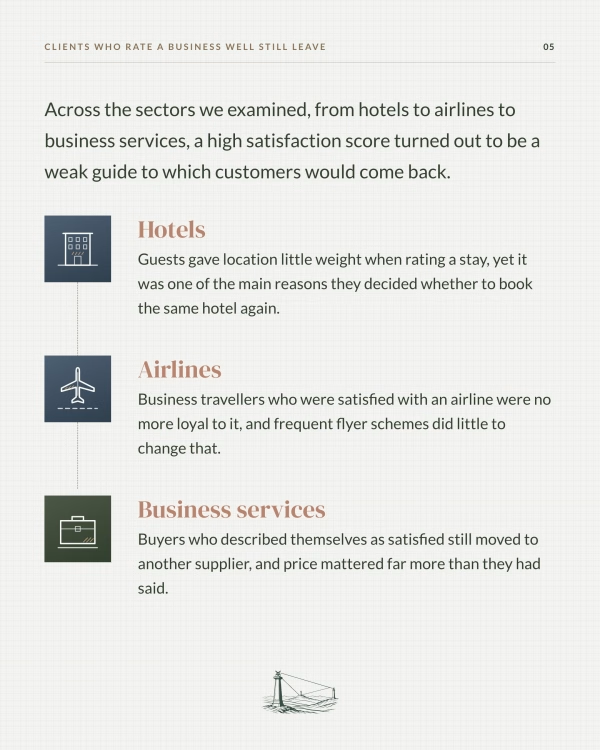
Across the sectors we examined, from hotels to airlines to business services, a high satisfaction score turned out to be a weak guide to which customers would come back.
Hotels
Guests gave location little weight when rating a stay, yet it was one of the main reasons they decided whether to book the same hotel again.
Airlines
Business travellers who were satisfied with an airline were no more loyal to it, and frequent flyer schemes did little to change that.
Business services
Buyers who described themselves as satisfied still moved to another supplier, and price mattered far more than they had said.
Two Clients Tick Satisfied, but Only One Is Committed
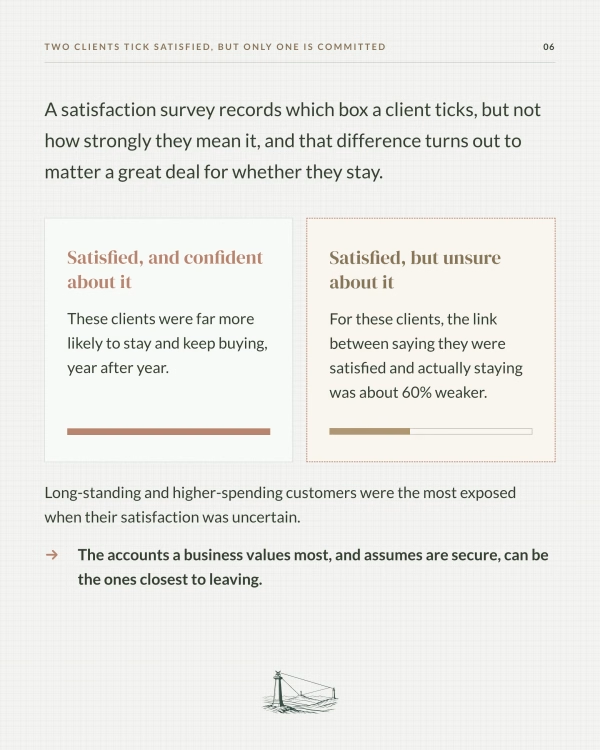
A satisfaction survey records which box a client ticks, but not how strongly they mean it, and that difference turns out to matter a great deal for whether they stay.
Satisfied, and confident about it
These clients were far more likely to stay and keep buying, year after year.
Satisfied, but unsure about it
For these clients, the link between saying they were satisfied and actually staying was about 60% weaker.
Long-standing and higher-spending customers were the most exposed when their satisfaction was uncertain.
The accounts a business values most, and assumes are secure, can be the ones closest to leaving.
Spending Falls Before a Client Says Anything
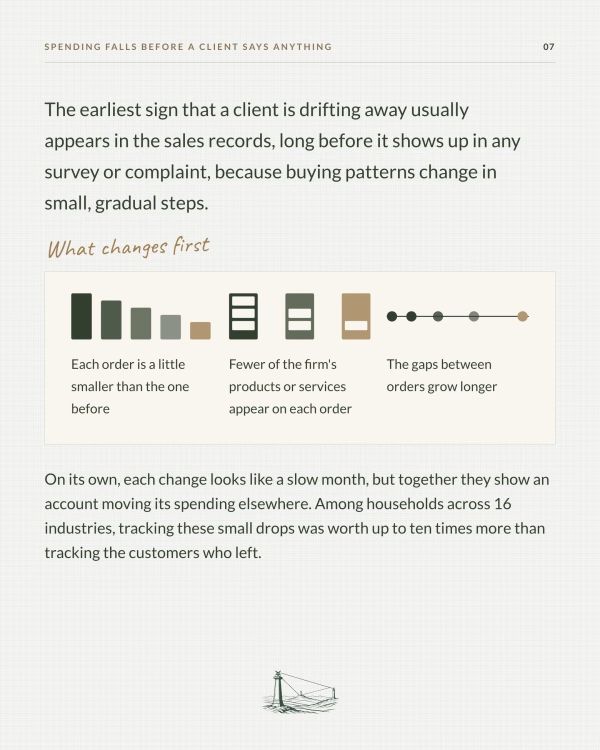
The earliest sign that a client is drifting away usually appears in the sales records, long before it shows up in any survey or complaint, because buying patterns change in small, gradual steps.
What changes first
Each order is a little smaller than the one before
Fewer of the firm's products or services appear on each order
The gaps between orders grow longer
On its own, each change looks like a slow month, but together they show an account moving its spending elsewhere. Among households across 16 industries, tracking these small drops was worth up to ten times more than tracking the customers who left.
DROMLEY INTELLIGENCE · CUSTOMER INSIGHTS & SEGMENTATION
We find which clients are drifting away, and why, before they tell you.
We bring your sales data, support history and client conversations together, so you can see which accounts are at risk while there is still time to keep them.
The signals we bring together
How each client's spending is changing, order by order
What clients raise in support tickets, complaints and everyday emails
Interviews with your clients, worded to get the real reason they would leave, not the polite one
What you can act on
The accounts most at risk, with the reason behind each one
Which of them are worth the effort to keep, ranked by value
What to change in pricing, service or attention for each
How we work
Senior people on the work, priced for mid-market businesses
A clear plan agreed with you, not a report left on your desk
Book a Briefing Call · dromley.com
Sources & Further Reading
- Reaching the breaking point: a dynamic process theory of business-to-business customer defection, Journal of the Academy of Marketing Science (2014). Hollmann, Jarvis and Bitner
- Evolving customer expectations of hospitality services: Differences in attribute effects on satisfaction and re-patronage, Tourism Management (2019). Hu et al.
- Understanding the causes of defection among satisfied B2B service customers, Journal of Marketing Management (2010). Naumann et al.
- Satisfaction Strength and Customer Loyalty, Journal of Marketing Research (2007). Chandrashekaran et al.
- Customer retention is not enough, Journal of Consumer Marketing (2005). Coyles and Gokey
Decks are easy. Decisions are not.
Bring us the real question. We’ll come back with how we’d approach it. Not a brochure. A starting point.
Book a Briefing Call