Market Reads Brand Tracking & Demand
Know Whether AI Search Actually Names Your Brand Today
Searches increasingly end in an AI answer rather than a click. The analysis explains why rankings no longer show whether buyers hear a brand's name, and how to trace what AI systems cite.
Overview
For years, search performance was judged by rankings and the visits they produced. This analysis looks at why that measure now tells a business less. Clickstream research finds that most searches finish without a visit to any website, and studies of click-through rates show clicks falling sharply once an AI summary sits at the top of the page. Informational questions, the kind many content programmes were designed to win, are among the most affected. The outcome that matters is shifting from where a page ranks to whether a brand is named inside the answer a buyer reads, and brands that are named appear to keep more of the remaining traffic. The piece examines why producing more of the same content rarely closes that gap, and why automated visibility scores can be hard to verify. It then describes a different method: putting the questions real buyers ask to the main AI assistants and tracing each answer back to the source being cited. It is written for owners and marketing leads.
The deck


What It Means
A ranking report can stay flat while a brand drops out of the answers buyers actually read, so the first step is to measure that outcome directly. List the questions a real buyer would ask about the category, put them to the main AI assistants, and record which brands are named and which sources are cited for each. Where a competitor is named instead, the cited source shows what would need to change, whether that is a missing comparison page, an outdated listing or a third-party article the system relies on. Repeating the exercise at set intervals shows whether the position is improving. A score that cannot be traced back to specific prompts and sources is a weak basis for spending decisions. This is the method behind our AI discoverability audit, led by a senior partner and traced by hand, one prompt at a time.
Common Questions
What is an AI visibility audit?
An AI visibility audit assesses whether a brand appears in the answers AI assistants and AI search summaries give to the questions buyers ask. A useful audit records which brands are named for each question, which competitors appear instead, and which sources the answer draws on. It should be traceable to specific prompts, so the findings can be checked and repeated rather than taken on trust.
Why do good search rankings bring less traffic than before?
More searches now end on the results page itself, either because a short answer is shown directly or because an AI summary appears above the links. People who get what they need there have no reason to click. Informational searches are affected most. A page can therefore hold its position while the visits it produces fall, which is why rankings alone no longer describe how visible a brand is.
How do you get your brand mentioned in AI answers?
There is no guaranteed method, but the starting point is knowing which sources an AI system cites for the questions that matter to your buyers. Those may be comparison articles, directories, reviews or industry publications rather than your own site. Making sure your business is described accurately and consistently in those places, and publishing clear answers to the questions buyers ask, tends to improve the chance of being named.
Transcript
THE BASELINE
Here's the number worth sitting with.
More than half of all searches today end without a single click, on any result. Not a bad month, the baseline.
And the moment an AI answer appears above the results, click rates on everything below it fall by more than half again. The searches hit hardest are the informational ones. What is. How to. Best way to. The exact queries most content strategies were built to win, back when winning meant showing up in ten blue links a person would actually scroll through and click.
NO CLICK ON ANY RESULT
AT LEAST ONE CLICK
Source says "more than half," a threshold, not an exact share. Bar proportions are illustrative, not a precise measured percentage split.
THE QUESTION MOST AUDITS NEVER ASK
Whether a ranking still earns a click once an AI answer sits above it, a number most reports leave out because it makes the rest of the report look worse.
THE FINISH LINE MOVED
The brands actually gaining ground right now aren't the ones ranking highest. They're the ones getting named.
None of this means the work stopped mattering. It means the finish line moved. Ranking well used to be enough, because ranking well got you the click. Now a growing share of buyers get their answer before they ever reach a results page, and that answer either names your brand or it doesn't.
RANKED
NAMED
Being ranked and being named are two different outcomes, measured two different ways, and most teams are still only tracking the one that used to matter most.
THE TARGET THAT STOPPED MATTERING AS MUCH
Position one, the same finish line agencies have measured success by for a decade, while more buyers stop scrolling past the answer before they ever reach it.
WHO GETS LEFT OUT
Getting named is not evenly distributed either.
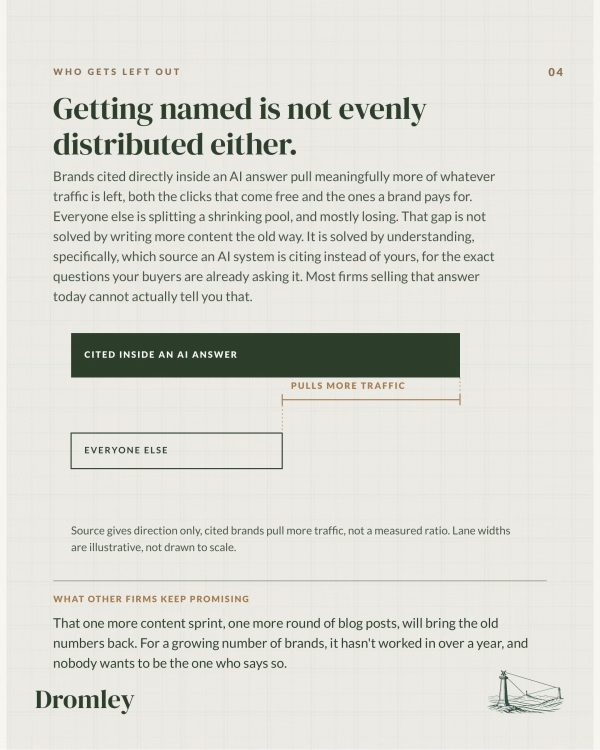
Brands cited directly inside an AI answer pull meaningfully more of whatever traffic is left, both the clicks that come free and the ones a brand pays for. Everyone else is splitting a shrinking pool, and mostly losing. That gap is not solved by writing more content the old way. It is solved by understanding, specifically, which source an AI system is citing instead of yours, for the exact questions your buyers are already asking it. Most firms selling that answer today cannot actually tell you that.
CITED INSIDE AN AI ANSWER PULLS MORE TRAFFIC
EVERYONE ELSE
Source gives direction only, cited brands pull more traffic, not a measured ratio. Lane widths are illustrative, not drawn to scale.
WHAT OTHER FIRMS KEEP PROMISING
That one more content sprint, one more round of blog posts, will bring the old numbers back. For a growing number of brands, it hasn't worked in over a year, and nobody wants to be the one who says so.
WHAT GETS SOLD INSTEAD
Somewhere at the bottom sits the actual pitch, a retainer.
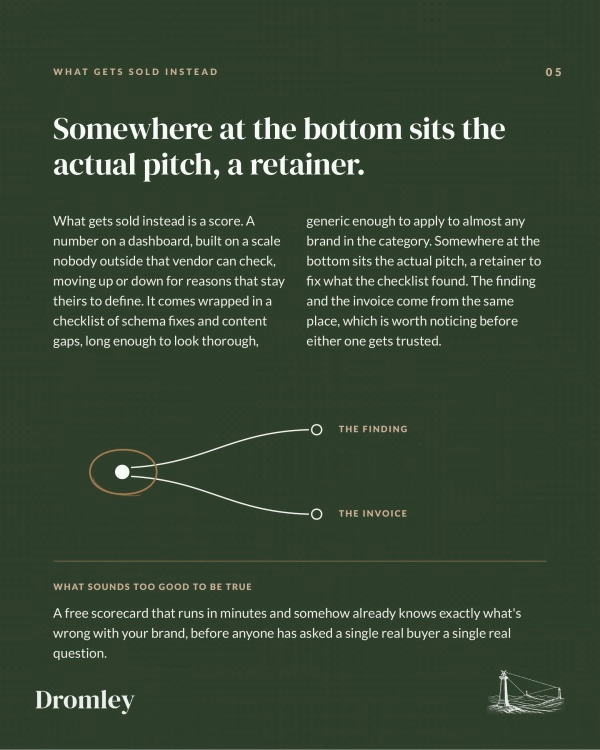
What gets sold instead is a score. A number on a dashboard, built on a scale nobody outside that vendor can check, moving up or down for reasons that stay theirs to define. It comes wrapped in a checklist of schema fixes and content gaps, long enough to look thorough, generic enough to apply to almost any brand in the category. Somewhere at the bottom sits the actual pitch, a retainer to fix what the checklist found. The finding and the invoice come from the same place, which is worth noticing before either one gets trusted.
THE FINDING
THE INVOICE
WHAT SOUNDS TOO GOOD TO BE TRUE
A free scorecard that runs in minutes and somehow already knows exactly what's wrong with your brand, before anyone has asked a single real buyer a single real question.
HOW WE RUN IT
The team that finds the gap is the one that closes it.
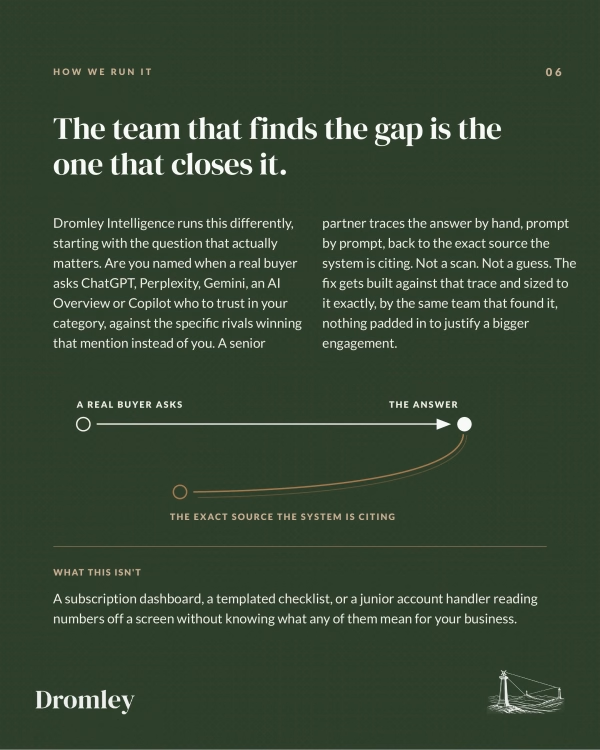
Dromley Intelligence runs this differently, starting with the question that actually matters. Are you named when a real buyer asks ChatGPT, Perplexity, Gemini, an AI Overview or Copilot who to trust in your category, against the specific rivals winning that mention instead of you. A senior partner traces the answer by hand, prompt by prompt, back to the exact source the system is citing. Not a scan. Not a guess. The fix gets built against that trace and sized to it exactly, by the same team that found it, nothing padded in to justify a bigger engagement.
A REAL BUYER ASKS
THE ANSWER
THE EXACT SOURCE THE SYSTEM IS CITING
WHAT THIS ISN'T
A subscription dashboard, a templated checklist, or a junior account handler reading numbers off a screen without knowing what any of them mean for your business.
THE QUESTION THAT MATTERS
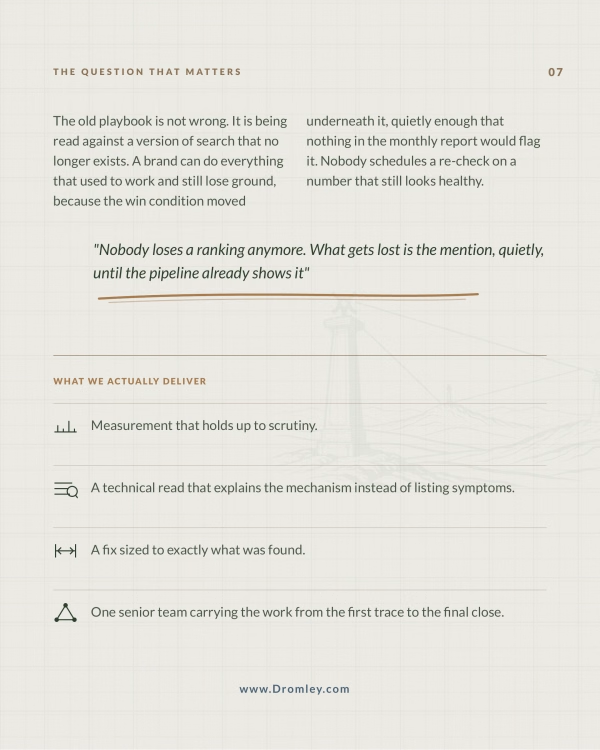
The old playbook is not wrong. It is being read against a version of search that no longer exists. A brand can do everything that used to work and still lose ground, because the win condition moved underneath it, quietly enough that nothing in the monthly report would flag it. Nobody schedules a re-check on a number that still looks healthy.
"Nobody loses a ranking anymore. What gets lost is the mention, quietly, until the pipeline already shows it"
WHAT WE ACTUALLY DELIVER
Measurement that holds up to scrutiny.
A technical read that explains the mechanism instead of listing symptoms.
A fix sized to exactly what was found.
One senior team carrying the work from the first trace to the final close.
Sources & Further Reading
- 2024 Zero-Click Search Study: For every 1,000 US Google searches, only 374 clicks go to the open web. In the EU, it's 360., SparkToro (2024). Fishkin
- AIO Impact on Google CTR: September 2025 Update, Seer Interactive (2025). Seer Interactive
- How Generative AI Disrupts Search: An Empirical Study of Google Search, Gemini, and AI Overviews, Proceedings of the 49th International ACM SIGIR Conference on Research and Development in Information Retrieval (2026). Grossman et al.
Decks are easy. Decisions are not.
Bring us the real question. We’ll come back with how we’d approach it. Not a brochure. A starting point.
Book a Briefing Call