Market Reads Growth & Revenue Marketing
Marketing Attribution for B2B: Proving Which Spend Works
Attribution reports credit sales to channels by a chosen rule, using only the sales that leave a trace. Holdout tests and spend set against revenue show what each channel actually earns.
Overview
When budgets tighten, most firms decide which marketing to cut by reading their attribution reports. This analysis asks whether those reports can carry that decision. Attribution does not measure what a channel caused; it applies a rule, such as first or last interaction, that shares out credit for each sale among the steps a buyer was recorded taking. The resulting figures rest on the part of the journey that is tracked, and in many mid-sized businesses many new customers can't be traced to any source at all. Recommendations, a rival's failure and a familiar name rarely appear in any system, while the final paid placement nearly always does. Field experiments, including Blake, Nosko and Tadelis's study of paid search at eBay, found that credit-based figures can greatly overstate what advertising adds, and Gordon and colleagues found that common observational methods often miss the results of controlled experiments. The piece then sets out a lower-risk alternative: pausing one channel in a matched group of regions, and reading monthly spend against monthly sales. It is written for owners, finance leads and heads of marketing.
The deck




What It Means
Before a channel is cut, the question worth asking is how much revenue depends on it, and that question needs a test rather than a report. A matched comparison, in which comparable regions or customer groups pause one channel for a single buying cycle while others carry on, gives a direct reading at limited risk: if sales hold, the spend was adding little; if they fall, the channel has been priced. Alongside it, monthly spend set against monthly sales from the company's own accounts shows where each channel's returns begin to level off. Neither source is compiled by the agency or platform running the media, which makes both easier to trust. This is the basis of our marketing channel attribution work, which recommends a budget per channel and estimates the return on any additional spend.
Common Questions
What does attribution mean in advertising?
Attribution is the practice of assigning credit for a sale to the marketing a buyer encountered beforehand. Common approaches credit the first interaction, the last one, or share it across several. Whatever the approach, it divides credit among recorded interactions only, so it describes which activities appeared before a sale rather than which ones caused it.
What is marketing channel attribution?
Marketing channel attribution applies that credit-sharing to channels such as search, social, email, events and referrals, so their returns can be compared and budgets set. Its weak points are worth knowing: many sales carry no record of their source, several platforms can claim the same customer, and each figure is usually reported by the party running that channel. It is a useful guide, but a poor basis for cutting spend on its own.
How can you tell whether a marketing channel is actually working?
The most direct method is a controlled test. Pause or reduce one channel in some regions or customer groups, keep it running in comparable ones, and compare sales across a full buying cycle. The gap in sales between them shows the channel's contribution. A second check is to compare monthly spend on each channel with monthly sales over a long period, which shows where extra spending stops producing extra revenue.
Transcript
THE DECISION EVERY COMPANY MAKES
Planning season. Marketing has to give back a number, and something has to stop.
Four candidates always come up.
The one with the weakest figures.
The newest one, because it has the least to show for itself.
The one nobody can explain in a single sentence.
Or a flat reduction across all of them, so nobody has to argue.
Each sounds reasonable in the room.
None of them is evidence.
They are preferences, and the difference matters, because a preference cannot tell you what the company loses on the day the spending stops.
WHAT ATTRIBUTION ACTUALLY IS
Six things touched a sale before it closed. Attribution is the rule that decides which one gets the credit.
That is the whole of it. Not a measurement. A rule. Somebody chose it, usually years ago, often by default, and it has been dividing credit quietly ever since.
the last step
the first
Give the credit to the last step, and the channels sitting closest to the sale look strongest. Give it to the first, and the work that began the relationship does.
Same customers, same money, same year, different winner.
So before anyone argues about the figure, it is worth asking who set the rule that produced it.
THREE THINGS THAT FIGURE CANNOT ACCOUNT FOR
The silence.
A large share of new business arrives with nothing recorded about where it came from.
The overlap.
One buying group, several suppliers, each counting the same customer as their own. Add every claim together and the total comes to more than the company actually earned.
The source.
Each figure is prepared by the party whose performance it describes.
Take them in order. The first means most of the evidence is missing. The second means what remains is counted more than once. The third means nobody independent has checked either.
That is the document a year of spending gets decided on.
HOW LARGE IS THE SILENCE
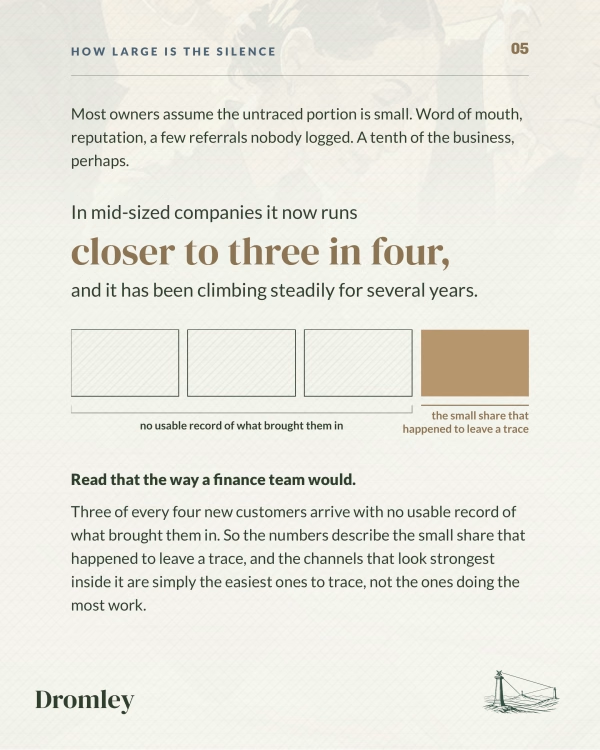
Most owners assume the untraced portion is small. Word of mouth, reputation, a few referrals nobody logged. A tenth of the business, perhaps.
In mid-sized companies it now runs
closer to three in four,
and it has been climbing steadily for several years.
the small share that happened to leave a trace
Read that the way a finance team would.
Three of every four new customers arrive with no usable record of what brought them in. So the numbers describe the small share that happened to leave a trace, and the channels that look strongest inside it are simply the easiest ones to trace, not the ones doing the most work.
WHERE THEY ARRIVED FROM IS NOT WHY THEY CAME
Ask a business owner why their largest customer chose them. The answer is never the last advertisement that customer happened to see.
It is that someone credible recommended them.
One thing is written down: the last step before the purchase.
That an existing supplier had let the customer down.
The advertisement served, the page opened, the message clicked.
That the name had been familiar for two years and felt like the safe choice when the requirement finally appeared.
It gets counted because it is the only part that leaves a record.
None of those reasons are written down anywhere in the business.
THE CUSTOMER WHO WAS ALREADY COMING
A buyer is four months into a decision. Two private conversations with people they trust. A view of your company formed long before there was any requirement. By the time the budget is approved internally, the choice is effectively made.
the budget is approved internally
a placement you paid for
the full value of the sale
Near the end of all that, your company appears in front of them one more time, in a placement you paid for.
That single placement now carries the full value of the sale, and it looks like the best money you spent all year.
It arrived after the decision, not before it.
Worth sitting with that one for a moment.
WHY TOUCH SOMETHING THAT ISN'T BROKEN
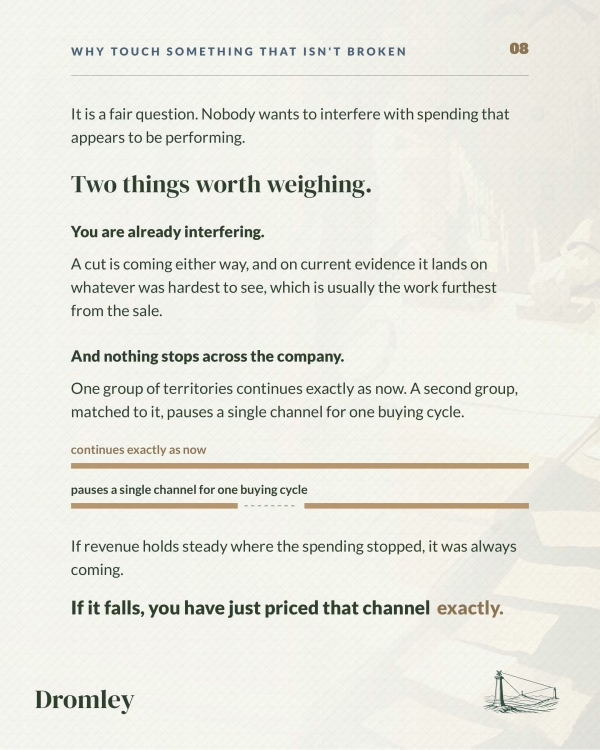
It is a fair question. Nobody wants to interfere with spending that appears to be performing.
Two things worth weighing.
You are already interfering.
continues exactly as now
A cut is coming either way, and on current evidence it lands on whatever was hardest to see, which is usually the work furthest from the sale.
And nothing stops across the company.
One group of territories continues exactly as now. A second group, matched to it, pauses a single channel for one buying cycle.
pauses a single channel for one buying cycle
If revenue holds steady where the spending stopped, it was always coming.
If it falls, you have just priced that channel exactly.
WHAT WE AT DROMLEY INTELLIGENCE DO
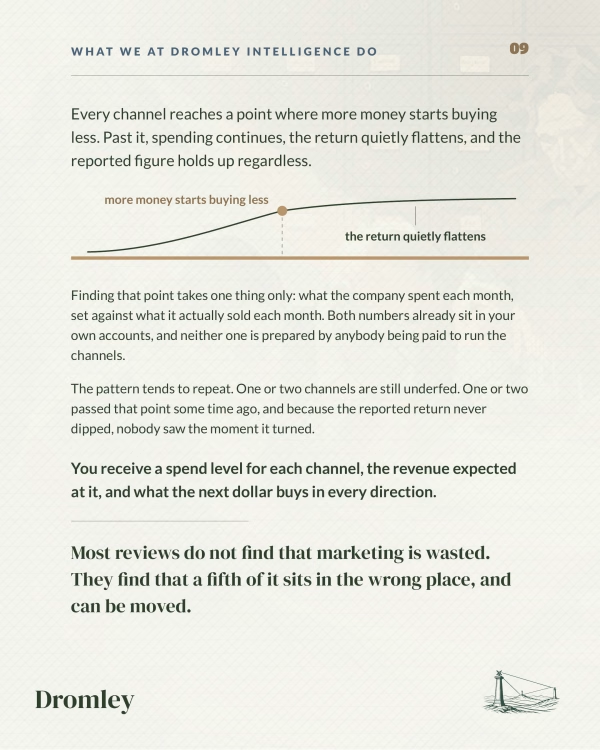
Every channel reaches a point where more money starts buying less. Past it, spending continues, the return quietly flattens, and the reported figure holds up regardless.
more money starts buying less
the return quietly flattens
Finding that point takes one thing only: what the company spent each month, set against what it actually sold each month. Both numbers already sit in your own accounts, and neither one is prepared by anybody being paid to run the channels.
The pattern tends to repeat. One or two channels are still underfed. One or two passed that point some time ago, and because the reported return never dipped, nobody saw the moment it turned.
You receive a spend level for each channel, the revenue expected at it, and what the next dollar buys in every direction.
Most reviews do not find that marketing is wasted. They find that a fifth of it sits in the wrong place, and can be moved.
Sources & Further Reading
- Consumer Heterogeneity and Paid Search Effectiveness: A Large-Scale Field Experiment, Econometrica (2015). Blake, Nosko and Tadelis
- A Comparison of Approaches to Advertising Measurement: Evidence from Big Field Experiments at Facebook, Marketing Science (2019). Gordon et al.
- The Unfavorable Economics of Measuring the Returns to Advertising, The Quarterly Journal of Economics (2015). Lewis and Rao
Decks are easy. Decisions are not.
Bring us the real question. We’ll come back with how we’d approach it. Not a brochure. A starting point.
Book a Briefing Call