Market Reads Customer Insights & Segmentation
The B2B Ideal Customer Profile Built on the Wrong Customers
Most guides build an ideal customer profile from a firm's best customers. Research on customer concentration and on studying only past buyers suggests that method copies the wrong accounts.
Overview
An ideal customer profile should identify the companies most worth targeting, yet it ends up steering list buying, sales targeting, hiring and marketing spend. That makes the way it is built important, and the standard advice is to model the profile on your best existing customers. This analysis tests that advice. It first separates the profile, which describes the target company, from the buyer persona, which describes the people inside it. It then looks at the accounts businesses tend to copy: the largest and most visible. Research by Saboo, Kumar and Anand on 1,023 newly listed firms found that greater dependence on a few major customers was followed by lower supplier profitability, consistent with buyers using their bargaining power. Work on customer acquisition by Thomas shows that conclusions drawn only from customers who were won can be biased. Loyalty, often treated as proof of fit, is also examined against the cost of serving each account. The piece closes with the wider set of sources a sound profile should draw on. It is written for founders, sales leaders and marketing heads.
The deck

What It Means
A profile built only from current customers reflects the accounts a business has managed to win and keep, not necessarily the ones it should pursue. A more reliable profile ranks current customers by the margin left after discounts, service and payment terms, rather than by deal size or logo value. It adds the reasons given by customers who left and by prospects who chose a competitor, since both reveal where the offer falls short. It also draws on those who sign off purchases, who can say what decided the outcome. The result is usually a shorter list of target companies, each more likely to buy on sound terms and to stay profitable. This is how our customer insights and segmentation team builds a profile from primary research with customers, former customers and prospects.
Common Questions
How do you define an ideal customer profile?
An ideal customer profile sets out the type of company worth targeting: its headcount, sector, typical spend and the triggers that prompt a purchase. A useful definition also covers profitability, meaning how much each account leaves once discounts, service and payment terms are counted. It then guides which accounts sales pursues, which contact lists are bought and where marketing budget goes.
What is the difference between an ICP and a buyer persona?
An ideal customer profile covers a company, while a buyer persona describes a person within it. The profile sets out which organisations to target, by size, sector, spend and readiness to buy. The persona covers the role, priorities and influence of the individuals involved, including who approves a purchase and who can block it. Most B2B sales efforts need both, and confusing them sends effort in the wrong direction.
What is an example of an ideal customer profile?
A software supplier might define its profile as manufacturing firms with 200 to 1,000 employees, a dedicated operations team, an ageing planning system and annual spend above a set threshold, where existing accounts of that type pay on time and need little custom work. The example is illustrative. What makes it useful is that each criterion can be checked against real profit and retention, not only revenue.
Transcript
The brief for almost everything
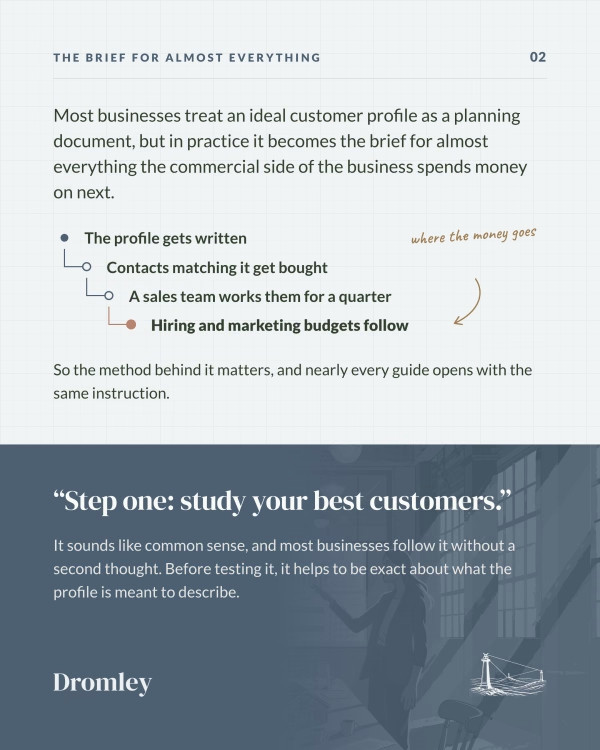
Most businesses treat an ideal customer profile as a planning document, but in practice it becomes the brief for almost everything the commercial side of the business spends money on next.
The profile gets written
where the money goes
Contacts matching it get bought
A sales team works them for a quarter
Hiring and marketing budgets follow
So the method behind it matters, and nearly every guide opens with the same instruction.
“Step one: study your best customers.”
It sounds like common sense, and most businesses follow it without a second thought. Before testing it, it helps to be exact about what the profile is meant to describe.
Whoever replies first
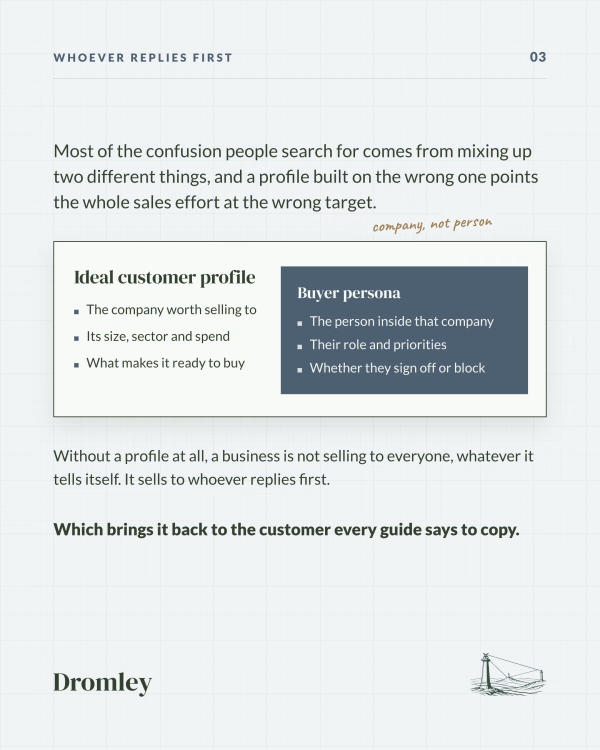
Most of the confusion people search for comes from mixing up two different things, and a profile built on the wrong one points the whole sales effort at the wrong target.
company, not person
Ideal customer profile
The company worth selling to
Its size, sector and spend
What makes it ready to buy
Buyer persona
The person inside that company
Their role and priorities
Whether they sign off or block
Without a profile at all, a business is not selling to everyone, whatever it tells itself. It sells to whoever replies first.
Which brings it back to the customer every guide says to copy.
Best customer, or one of the worst
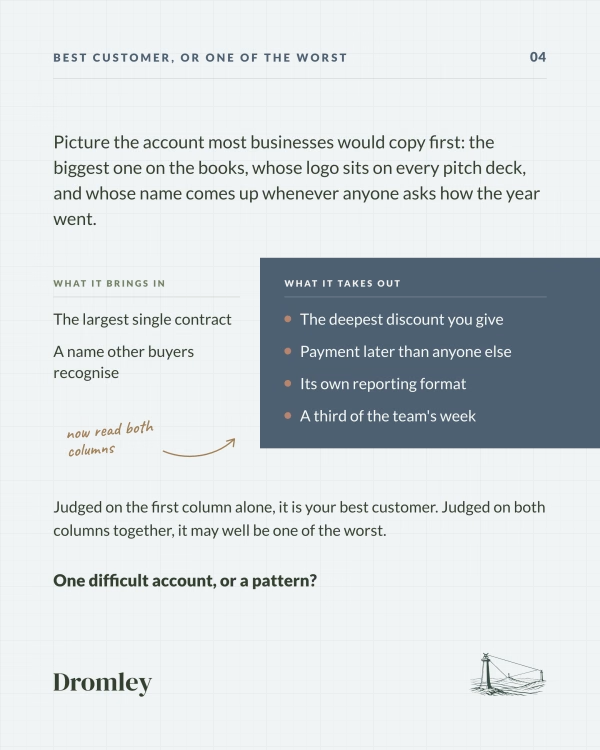
Picture the account most businesses would copy first: the biggest one on the books, whose logo sits on every pitch deck, and whose name comes up whenever anyone asks how the year went.
What it brings in
The largest single contract
A name other buyers recognise
What it takes out
The deepest discount you give
Payment later than anyone else
Its own reporting format
A third of the team's week
now read both columns
Judged on the first column alone, it is your best customer. Judged on both columns together, it may well be one of the worst.
One difficult account, or a pattern?
Bargaining power
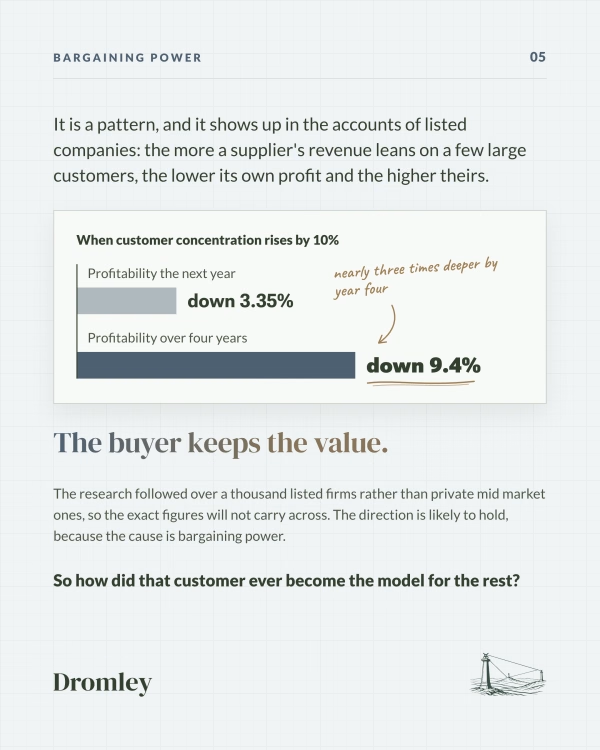
It is a pattern, and it shows up in the accounts of listed companies: the more a supplier's revenue leans on a few large customers, the lower its own profit and the higher theirs.
When customer concentration rises by 10%
Profitability the next year
down 3.35%
nearly three times deeper by year four
Profitability over four years
down 9.4%
The buyer keeps the value.
The research followed over a thousand listed firms rather than private mid market ones, so the exact figures will not carry across. The direction is likely to hold, because the cause is bargaining power.
So how did that customer ever become the model for the rest?
People who already said yes
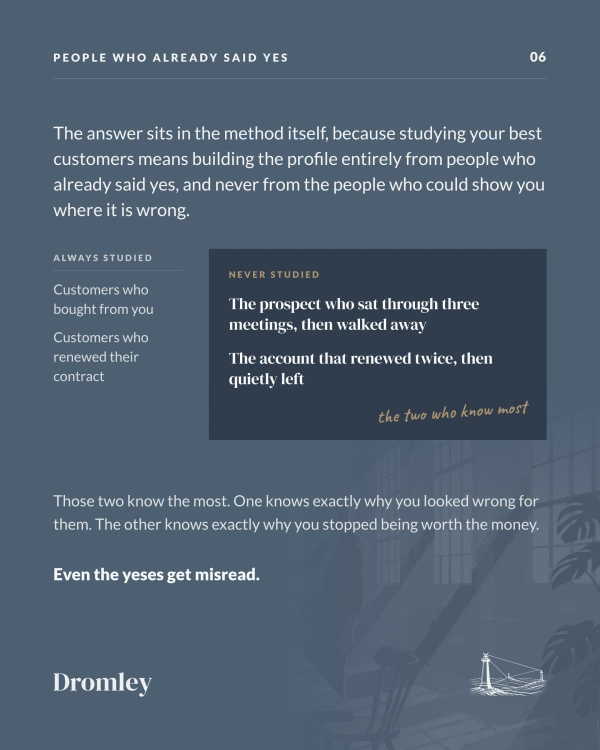
The answer sits in the method itself, because studying your best customers means building the profile entirely from people who already said yes, and never from the people who could show you where it is wrong.
Always studied
Customers who bought from you
Customers who renewed their contract
Never studied
The prospect who sat through three meetings, then walked away
The account that renewed twice, then quietly left
the two who know most
Those two know the most. One knows exactly why you looked wrong for them. The other knows exactly why you stopped being worth the money.
Even the yeses get misread.
The same test as revenue
The signal most guides lean on is loyalty, and it deserves the same test as revenue, because it is the one criterion almost nobody questions once it has been written into the profile.
The assumption
Low churn, meaning few customers leave, shows a good fit
What it takes for granted
That staying longer means earning more
What the research found
not in a single one of the six
Six groups of business customers, each fully costed
Did staying longer mean more profit?
Group 1 No
Group 2 No
Group 3 No
Group 4 No
Group 5 No
Group 6 No
With the true cost of each customer worked out, longer relationships did not go with higher profit in any group
A customer can stay for years and lose you money in every one of them.
The profile needs far more voices than it usually gets.
Worth buying from
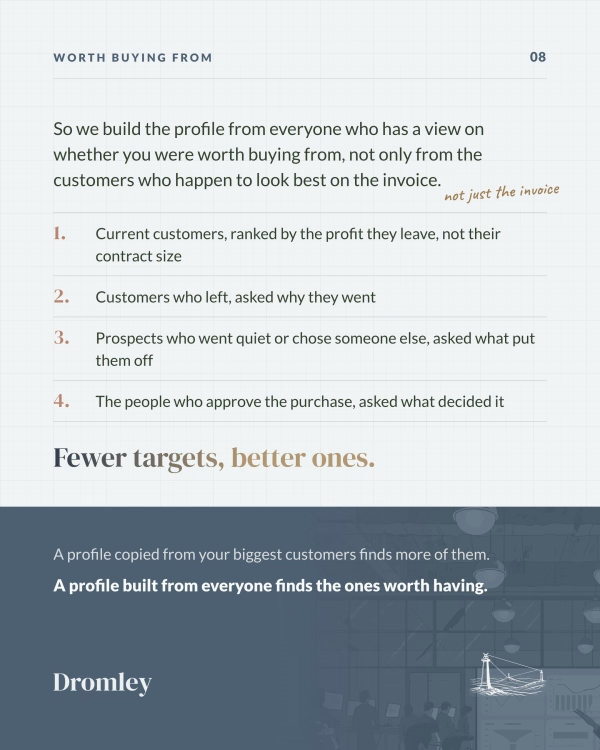
So we build the profile from everyone who has a view on whether you were worth buying from, not only from the customers who happen to look best on the invoice.
not just the invoice
1. Current customers, ranked by the profit they leave, not their contract size
2. Customers who left, asked why they went
3. Prospects who went quiet or chose someone else, asked what put them off
4. The people who approve the purchase, asked what decided it
Fewer targets, better ones.
A profile copied from your biggest customers finds more of them.
A profile built from everyone finds the ones worth having.
Sources & Further Reading
- Assessing the Impact of Customer Concentration on Initial Public Offering and Balance Sheet-Based Outcomes, Journal of Marketing (2017). Saboo, Kumar and Anand
- The Effects of Major Customer Networks on Supplier Profitability, Journal of Supply Chain Management (2017). Kim
- A Methodology for Linking Customer Acquisition to Customer Retention, Journal of Marketing Research (2001). Thomas
Decks are easy. Decisions are not.
Bring us the real question. We’ll come back with how we’d approach it. Not a brochure. A starting point.
Book a Briefing Call