Market Reads Brand Tracking & Demand
Why Brand Equity Is the First Budget Cut in B2B Companies
Brand spending is often cut first in B2B budget rounds because it reports in awareness, not in figures finance can verify. The analysis shows how to restate brand equity in commercial terms.
Overview
In annual budget rounds, the brand line tends to be the easiest to remove. Sales and operations report in bookings and unit costs, while brand reports in awareness scores and narrative, so it loses the argument even in the years it matters most. This analysis looks at why. It defines brand equity in practical terms: the advantage a company's name gives it before any conversation has taken place, from shortlist inclusion to holding price against a cheaper bid. It then examines the downturn research marketers usually cite and the B2B findings they tend to leave out. Srinivasan, Lilien and Sridhar found that in recessions B2B firms gained more from research and development than from advertising, while Currim, Lim and Zhang found that firms maintaining marketing spend saw better stock market returns later, so the honest reading is conditional. The piece argues that outside the business, lenders, buyers and acquirers tend to price a company's reputation already, and identifies three measures most firms can read from their own records. It is written for owners and finance leads.
The deck



What It Means
Brand spending is easier to defend, and to cut sensibly, once it is reported in the measures a finance team already trusts. Three readings usually sit in existing records: how revenue held up against the category in the most recent weak year, whether discounts have deepened over the past twelve months, and how many customers stayed during a period when they had reason to leave. To these can be added the terms lenders and acquirers offer, where reputation is priced every day. One further question is often missed: whether goodwill sits with the firm itself or with a few individuals, which matters for succession and for valuation. With those readings in hand, the budget conversation moves from belief to measurement. This is the basis of our brand tracking and demand work, which restates brand performance in price, retention and financing terms.
Common Questions
What is brand equity?
Brand equity means the commercial value a company gains from its name and reputation. In B2B it shows up in practical ways: being shortlisted without having to ask, getting replies from prospects who have not met you, and holding price against a lower bid. It accumulates slowly, often over years, which is why it is easy to overlook in a single year's budget.
How do you measure brand equity in B2B?
Survey measures of awareness and perception are common, but they rarely persuade a finance team. Firms can also read brand equity from records they already hold: revenue against the category during a downturn, the depth of discounting over time, customer retention under competitive pressure, and the terms offered by lenders or buyers of the business. Together these give a commercial reading that can be tracked year on year.
Should B2B companies cut brand spending in a recession?
The research does not give a single answer. One large study of recessions found that B2B firms gained more from investing in research and development than from advertising, while other work found that firms which kept up marketing spend saw better returns later. The sensible course is to judge brand spend on commercial measures such as price held and customers retained, and to decide on that basis rather than by habit.
Transcript
The line that always goes first
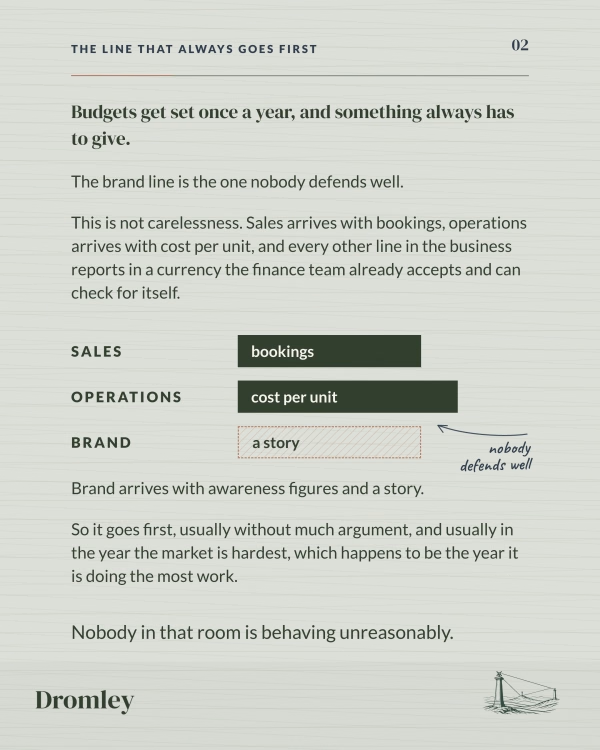
Budgets get set once a year, and something always has to give.
The brand line is the one nobody defends well.
This is not carelessness. Sales arrives with bookings, operations arrives with cost per unit, and every other line in the business reports in a currency the finance team already accepts and can check for itself.
Sales
bookings
Operations
cost per unit
Brand
a story
nobody defends well
Brand arrives with awareness figures and a story.
So it goes first, usually without much argument, and usually in the year the market is hardest, which happens to be the year it is doing the most work.
Nobody in that room is behaving unreasonably.
What brand equity means to an owner
Worth being clear about the term, because it gets used loosely by almost everyone who reaches for it.
Brand equity is what your name is worth in a buyer's decision before anyone has spoken to you.
The shortlist you are on without asking to be.
The call returned in a week rather than never.
The price you hold when a cheaper quote lands on the same desk that afternoon.
before anyone has spoken to you
It is what your reputation does to somebody else's behaviour, and most of it accumulates quietly, years before it shows up anywhere a report would catch it.
Why marketing loses this argument every year
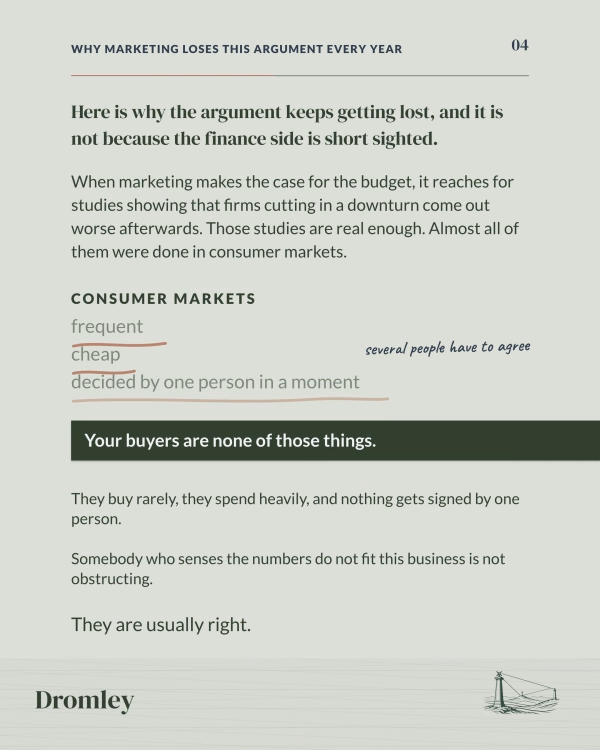
Here is why the argument keeps getting lost, and it is not because the finance side is short sighted.
When marketing makes the case for the budget, it reaches for studies showing that firms cutting in a downturn come out worse afterwards. Those studies are real enough. Almost all of them were done in consumer markets.
Consumer markets
frequent
cheap
decided by one person in a moment
several people have to agree
Your buyers are none of those things.
They buy rarely, they spend heavily, and nothing gets signed by one person.
Somebody who senses the numbers do not fit this business is not obstructing.
They are usually right.
The part the brand case never mentions
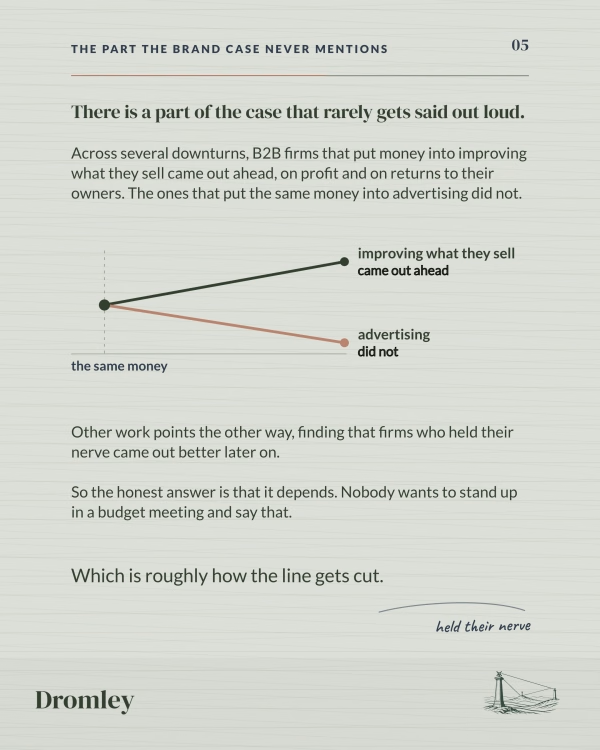
There is a part of the case that rarely gets said out loud.
Across several downturns, B2B firms that put money into improving what they sell came out ahead, on profit and on returns to their owners. The ones that put the same money into advertising did not.
improving what they sell
came out ahead
advertising
did not
the same money
Other work points the other way, finding that firms who held their nerve came out better later on.
So the honest answer is that it depends. Nobody wants to stand up in a budget meeting and say that.
held their nerve
Which is roughly how the line gets cut.
The benefit of the doubt
Here is the part that is not in dispute.
Two companies. Same size, same numbers, same sector.
one of them
keeps getting the benefit of the doubt
the other
has to earn it every single time
It happens when a bank sets your terms. It happens when a buyer picks between two quotes and has met neither of you. It happens when somebody puts a value on the business.
None of those decisions are made in front of you. In every one of them your name is doing some of the work, or failing to.
Same numbers. Different answer.
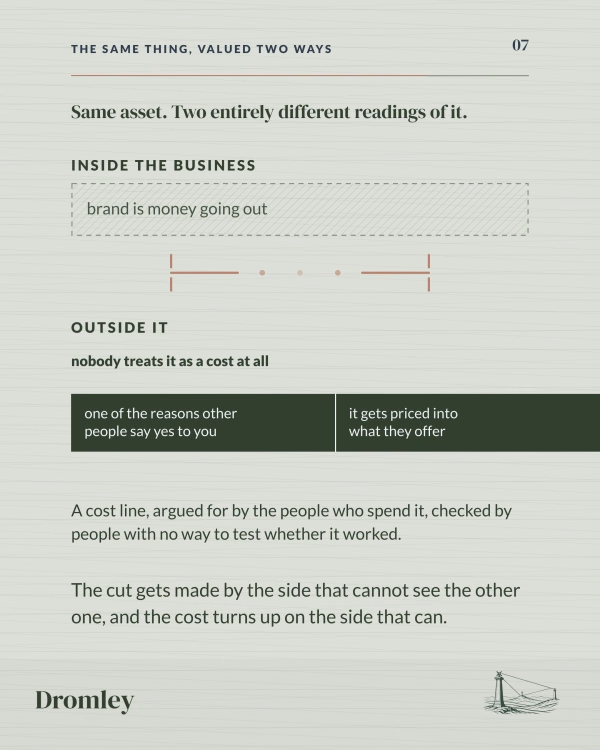
The same thing, valued two ways
Same asset. Two entirely different readings of it.
Inside the business
brand is money going out
Outside it
nobody treats it as a cost at all
one of the reasons other people say yes to you
it gets priced into what they offer
A cost line, argued for by the people who spend it, checked by people with no way to test whether it worked.
The cut gets made by the side that cannot see the other one, and the cost turns up on the side that can.
The readings you already hold
Three readings, all sitting in records you already hold.
your revenue against your category
your revenue
your category
your last bad year
a brand result
Holding steadier than the market while everyone around you was discounting is a brand result, whatever else anyone in the business decides to call it at the time.
the discount
Whether you are cutting your price more than you were a year ago.
who came back
Retention through a period when your buyers were under real pressure to leave.
None of this needs a survey. It needs somebody to look at what is already there.
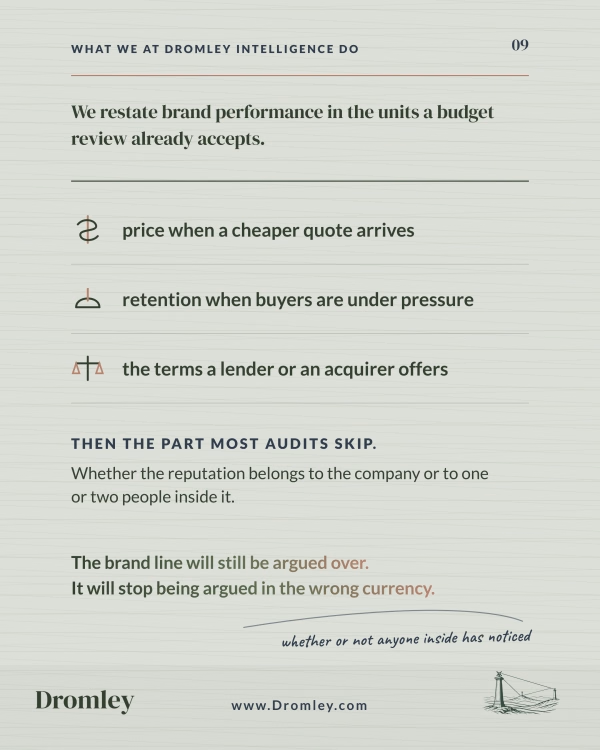
What we at Dromley Intelligence do
We restate brand performance in the units a budget review already accepts.
price when a cheaper quote arrives
retention when buyers are under pressure
the terms a lender or an acquirer offers
Then the part most audits skip.
Whether the reputation belongs to the company or to one or two people inside it.
The brand line will still be argued over. It will stop being argued in the wrong currency.
whether or not anyone inside has noticed
www.Dromley.com
Sources & Further Reading
- Should Firms Spend More on Research and Development and Advertising during Recessions?, Journal of Marketing (2011). Srinivasan, Lilien and Sridhar
- Commitment to marketing spending through recessions: Better or worse stock market returns?, European Journal of Marketing (2016). Currim, Lim and Zhang
Decks are easy. Decisions are not.
Bring us the real question. We’ll come back with how we’d approach it. Not a brochure. A starting point.
Book a Briefing Call